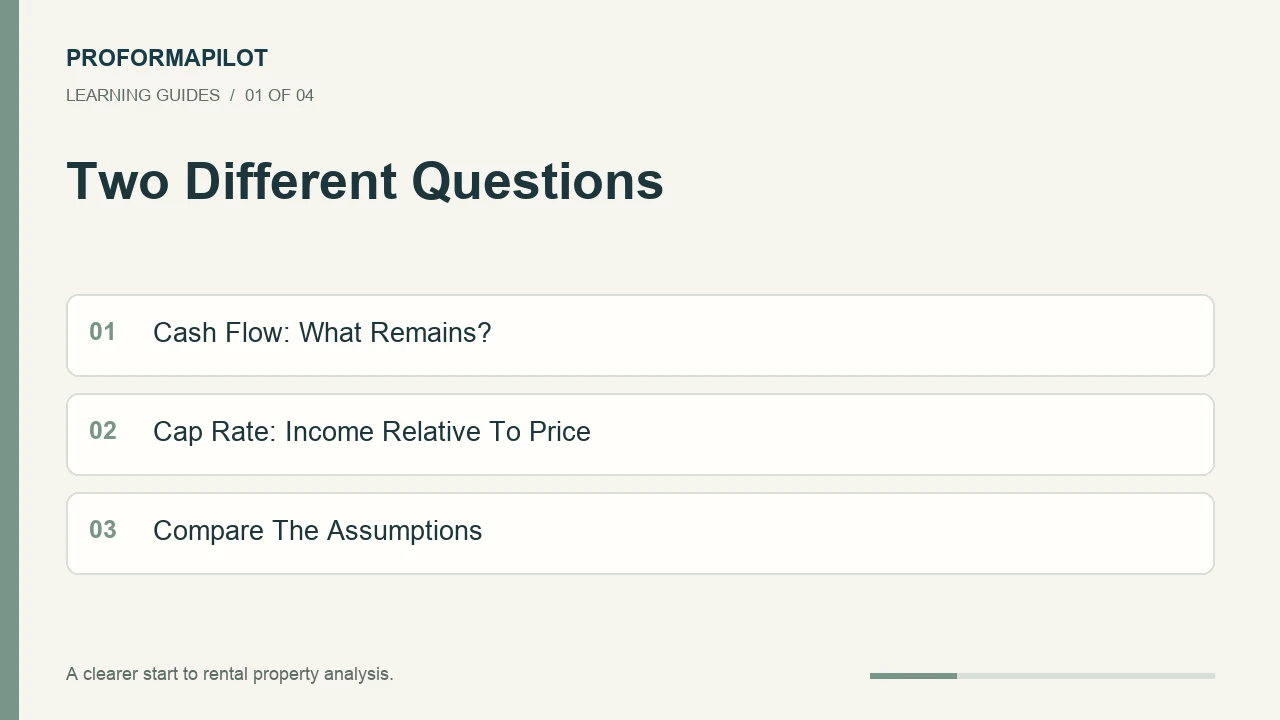
What Is Rental Cash Flow?
Projected cash flow is the modeled income remaining after operating costs, reserve allowances, and loan payments. ProformaPilot's rental cash-flow result is before income tax and reflects stabilized operation; actual cash flow can vary during repairs, vacancy, or lease-up.
Cash flow depends on financing. A larger loan payment reduces what remains even if the property earns the same rent. An all-cash purchase avoids loan payments but requires more capital. Cash flow alone does not show every risk or your total return.
What Is Cap Rate?
A conventional cap-rate calculation divides annual net operating income (NOI) by the property's value or purchase price. NOI measures operating income before debt service and capital reserves. To compare two cap rates fairly, use consistent income, expenses, and denominator assumptions.
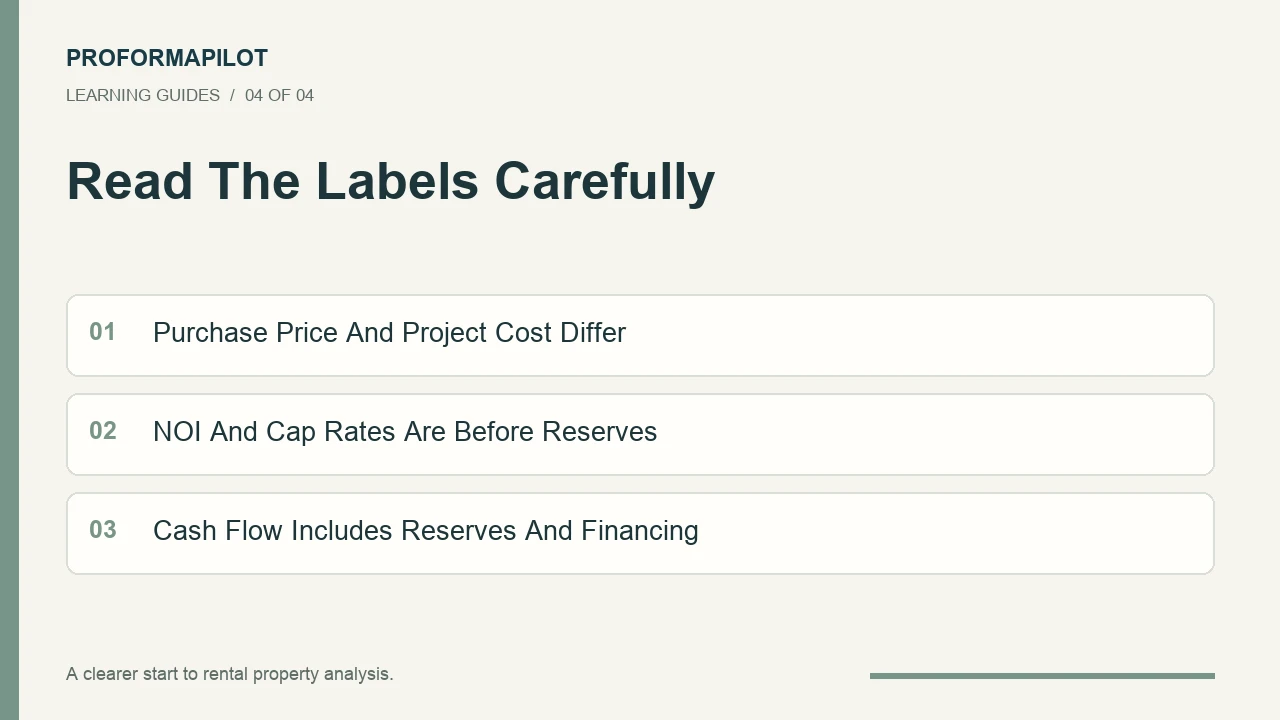
ProformaPilot's Residential Rental Analysis shows Cap Rate · Purchase Price and Cap Rate · Total Project Cost. Both use NOI before capital reserves and financing. Cash flow deducts the capital reserve allowance and loan payments. Renovation & Refinance uses a different after-reserves model, so read the result labels and methodology before comparing workflows.
Follow A Simple Example
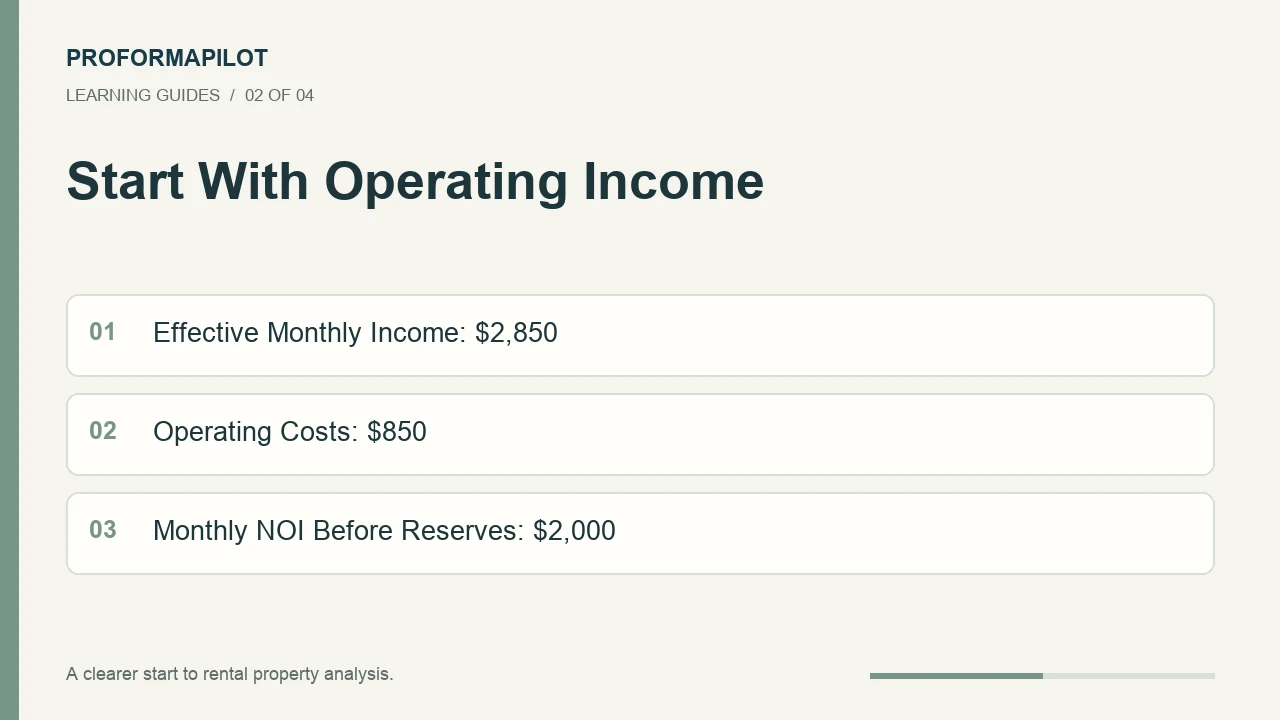
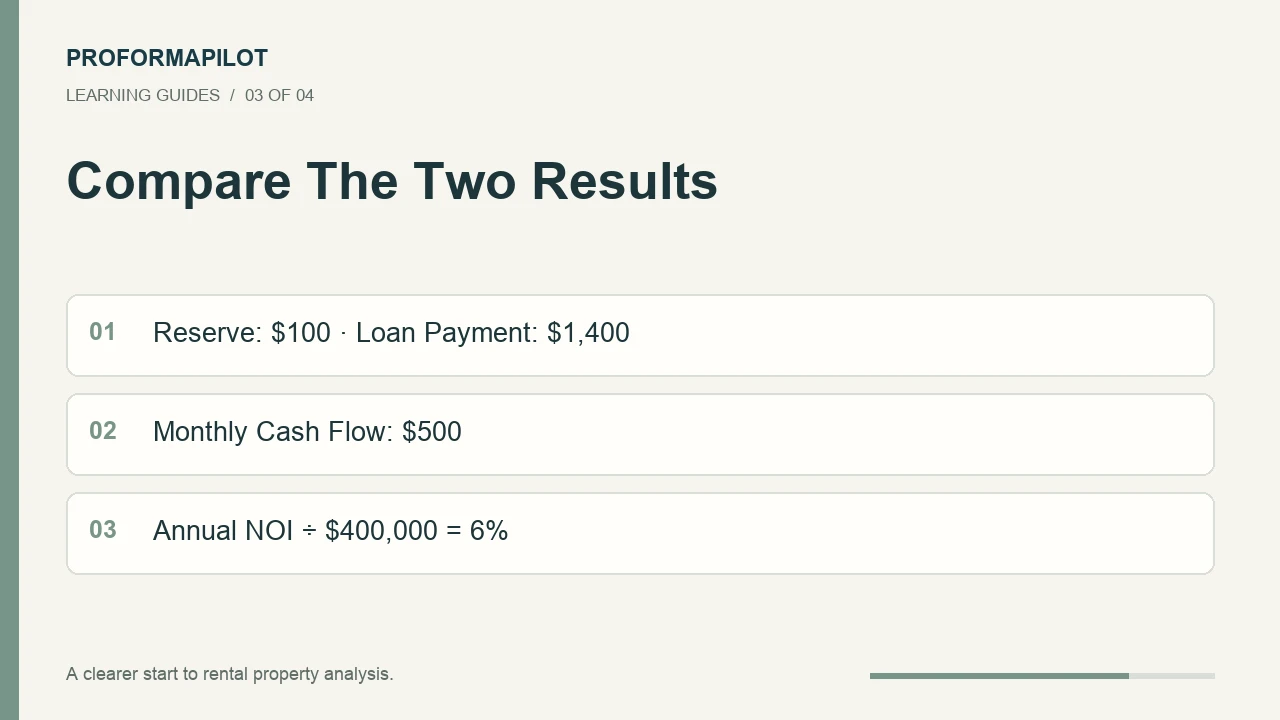
Suppose effective income after vacancy is $2,850 per month and operating costs are $850. NOI is $2,000 per month, or $24,000 per year. After a $100 monthly capital reserve allowance and a $1,400 monthly loan payment, projected cash flow is $500 per month.
At a $400,000 purchase price, $24,000 divided by $400,000 is a 6% price-based cap rate. If the cost basis is $420,000 instead, the same NOI gives about 5.7% on cost. If the loan payment rises to $1,700, cash flow falls to $200; the cap rate stays unchanged when NOI and the denominator stay the same.
Use Both In Your Analysis
Use cash flow to examine the effect of financing and the monthly budget. Use cap rate to understand operating income relative to the stated price, value, or cost. Neither measure is a guaranteed return or a complete investment decision.
In ProformaPilot, review income and expenses before comparing results, then change financing to see its effect. Keep appreciation, future rent growth, and refinance assumptions separate from facts you have verified today.
One Property, Two Views
Illustrative stabilized, pre-income-tax figures. NOI and cap rates are before reserves and financing; cash flow deducts both.
- Effective Income After Vacancy
- $2,850 / Month
- Operating Costs
- −$850 / Month
- NOI Before Reserves
- $2,000 / Month
- Capital Reserve Allowance
- −$100 / Month
- Principal And Interest
- −$1,400 / Month
- Projected Cash Flow
- $500 / Month
- Annual NOI / $400,000 Price
- 6%
- Annual NOI / $420,000 Cost
- About 5.7%
Keep These In Mind
- Cash flow includes the effect of financing.
- Cap rate excludes loan payments.
- Match the income, expense, and denominator assumptions.
Further Reading: CFPB: Principal And Interest Vs. Total Mortgage Payment. The CFPB explains why principal and interest differ from an escrow-inclusive payment. Separate financing from taxes and insurance when building your rental projection.