← Learning Guides
A Clearer Start

Which Rental Is Better? Compare The Full Budget

The property with more rent can still leave less cash each month. Compare the full ownership budget and the cash needed to begin, then investigate the risks behind the numbers.

4K Available · Captions Optional

Short Guided Video · Optional English Captions · Illustrative Examples

Read The Video Transcript

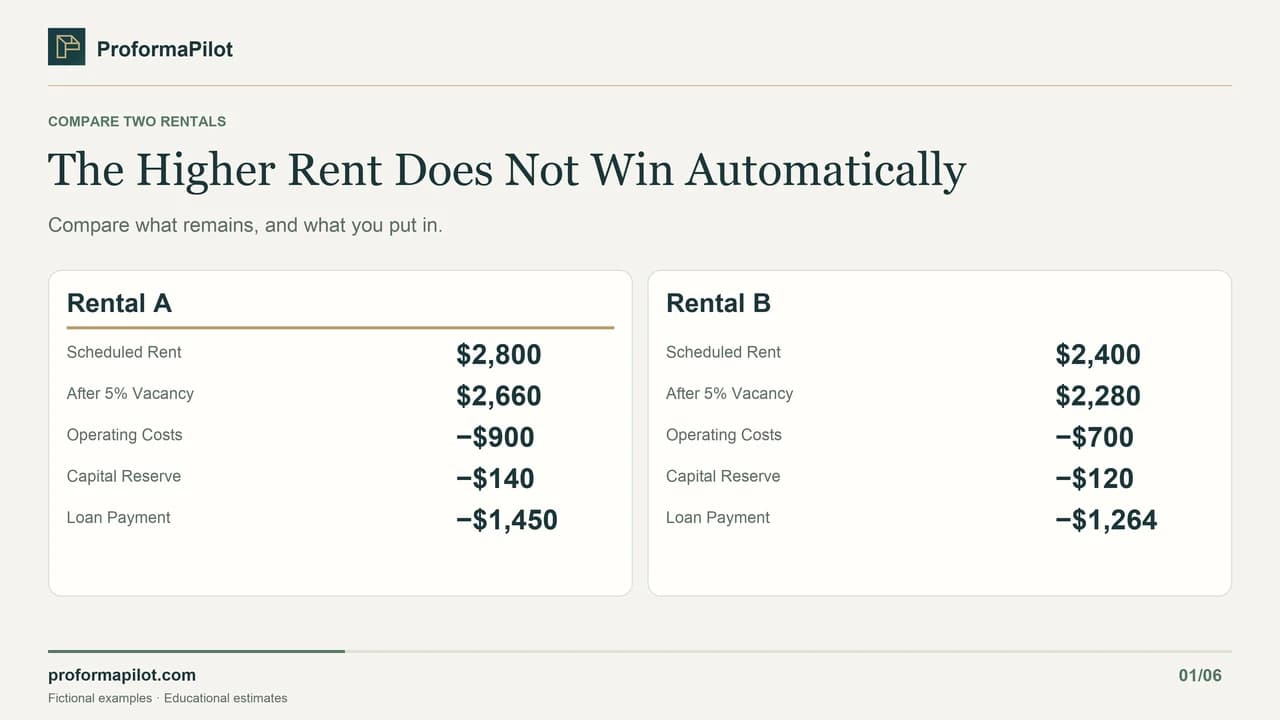
The Higher Rent Does Not Win Automatically

The Higher Rent Does Not Win Automatically: Compare what remains, and what you put in.
Step 1 · Illustrated Overview

You have found two rentals. One has a higher rent. Does that make it the better investment? Not automatically. Here is a fictional comparison that separates income, costs, and the cash you commit.

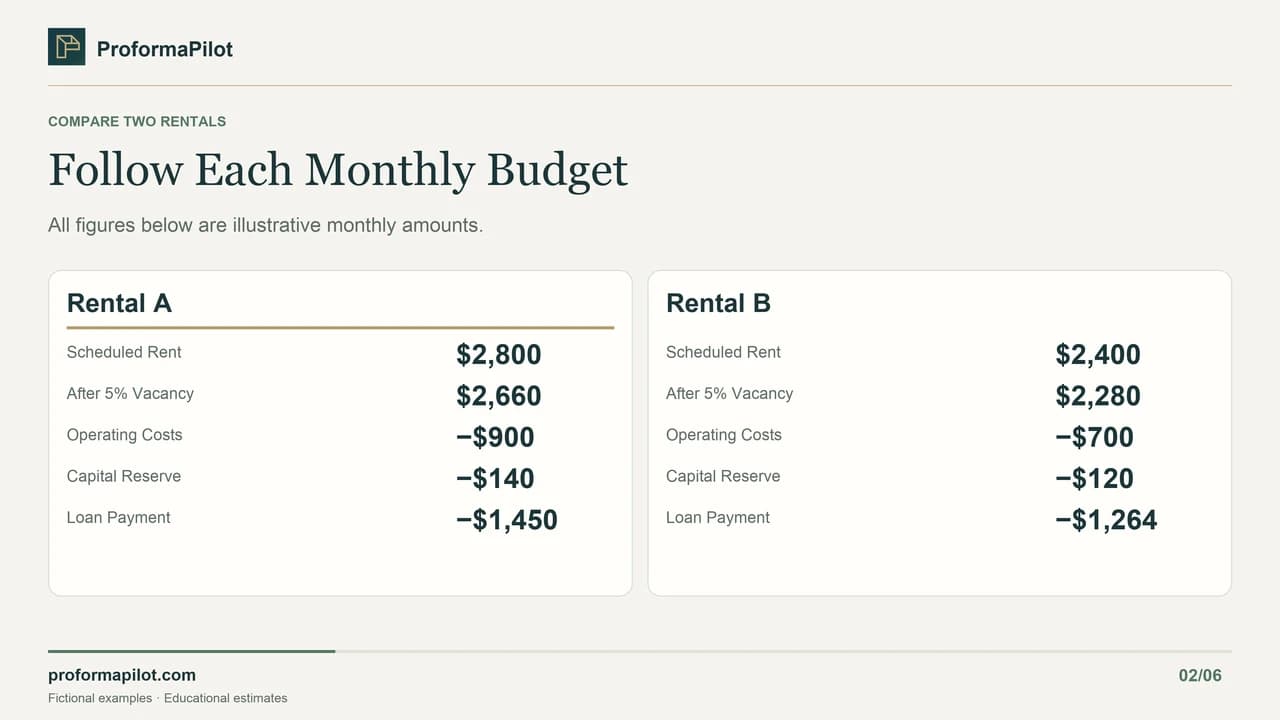
Follow Each Monthly Budget

Follow Each Monthly Budget: All figures below are illustrative monthly amounts.
Step 2 · Illustrated Overview

Rental A collects twenty-eight hundred dollars before vacancy. Rental B collects twenty-four hundred. Apply a five percent vacancy allowance to each, then subtract operating costs, reserves, and the assumed loan payment.

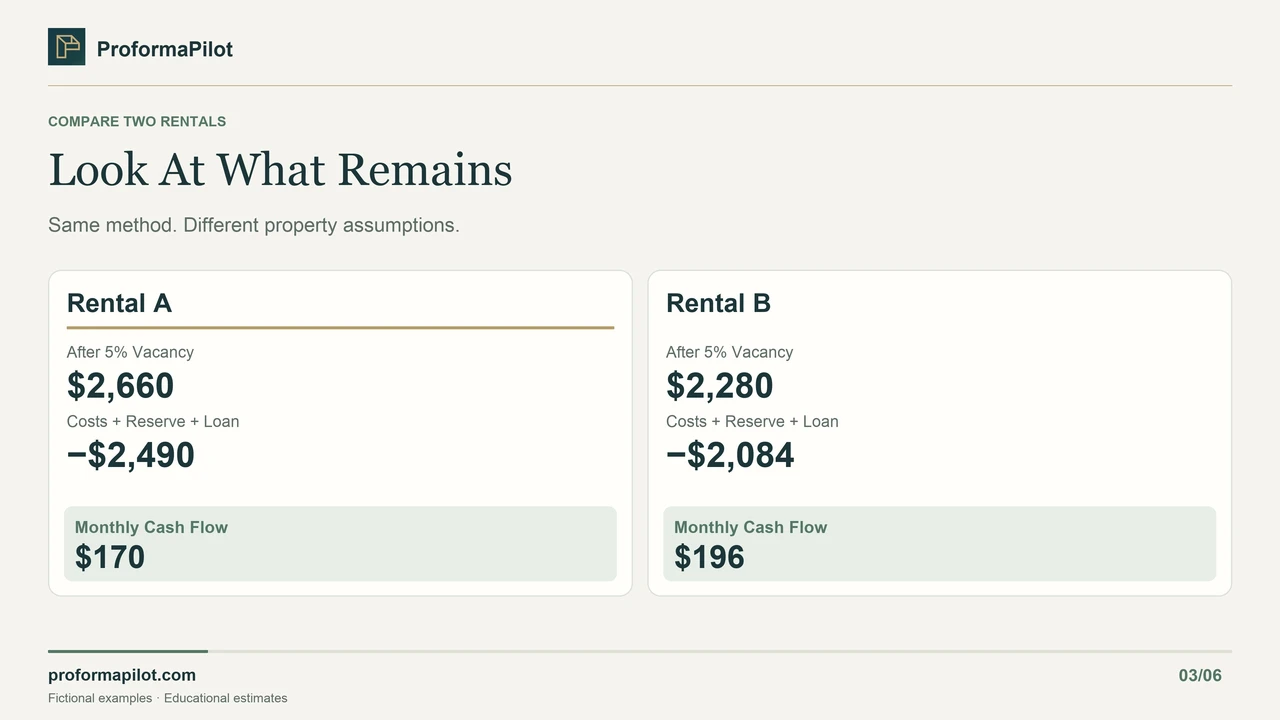
Look At What Remains

Look At What Remains: Same method. Different property assumptions.
Step 3 · Illustrated Overview

After these costs, the higher-rent property actually leaves less monthly cash flow. Its operating costs are nine hundred dollars, reserves are one hundred forty, and its loan payment is fourteen hundred fifty. That leaves one hundred seventy dollars. Rental B has seven hundred dollars of operating costs, one hundred twenty in reserves, and a twelve hundred sixty-four dollar loan payment. It leaves one hundred ninety-six dollars.

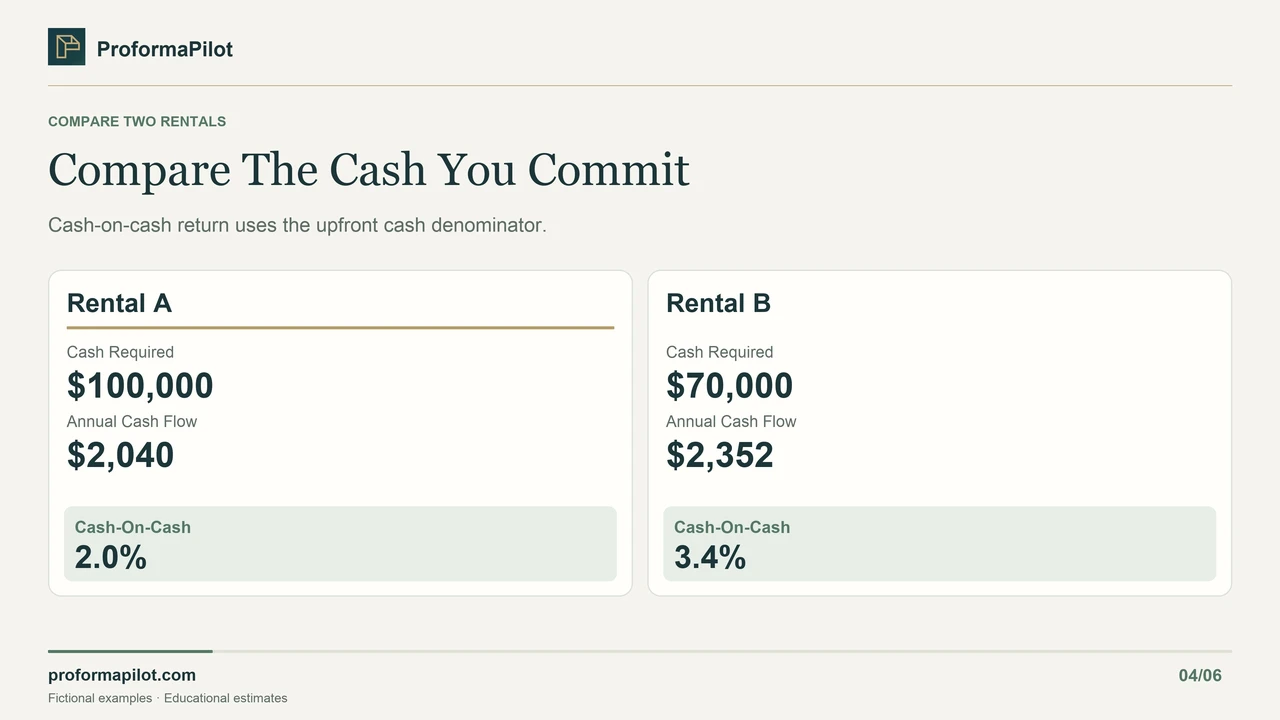
Compare The Cash You Commit

Compare The Cash You Commit: Cash-on-cash return uses the upfront cash denominator.
Step 4 · Illustrated Overview

Assume Rental A needs one hundred thousand dollars upfront and Rental B needs seventy thousand, including initial costs and reserves. Annualize each monthly cash flow and divide by that upfront cash. The modeled cash-on-cash returns are about two percent and three point four percent. These are illustrative operating returns before income taxes, not a complete forecast of investment performance.

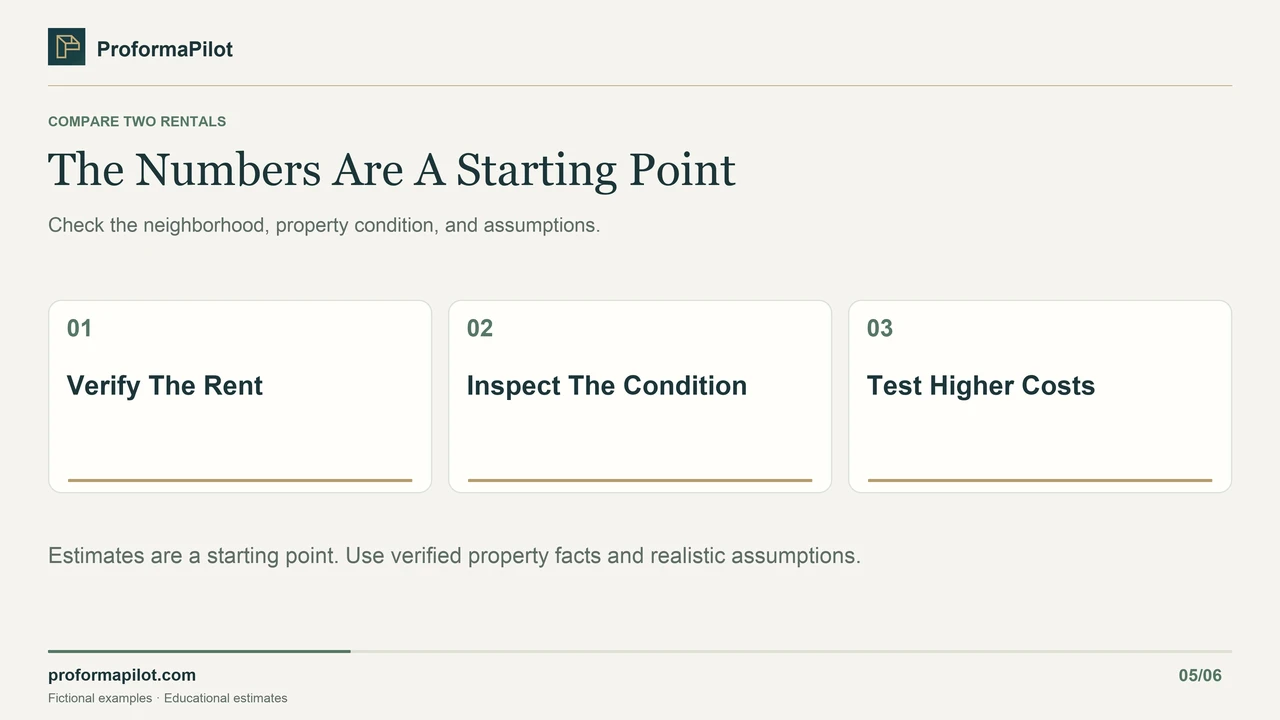
The Numbers Are A Starting Point

The Numbers Are A Starting Point: Check the neighborhood, property condition, and assumptions.
Step 5 · Illustrated Overview

A slightly better projection is not a guarantee. Verify rents, condition, taxes, insurance, and financing. Also consider your cash buffer and how the result changes when income falls or costs rise.

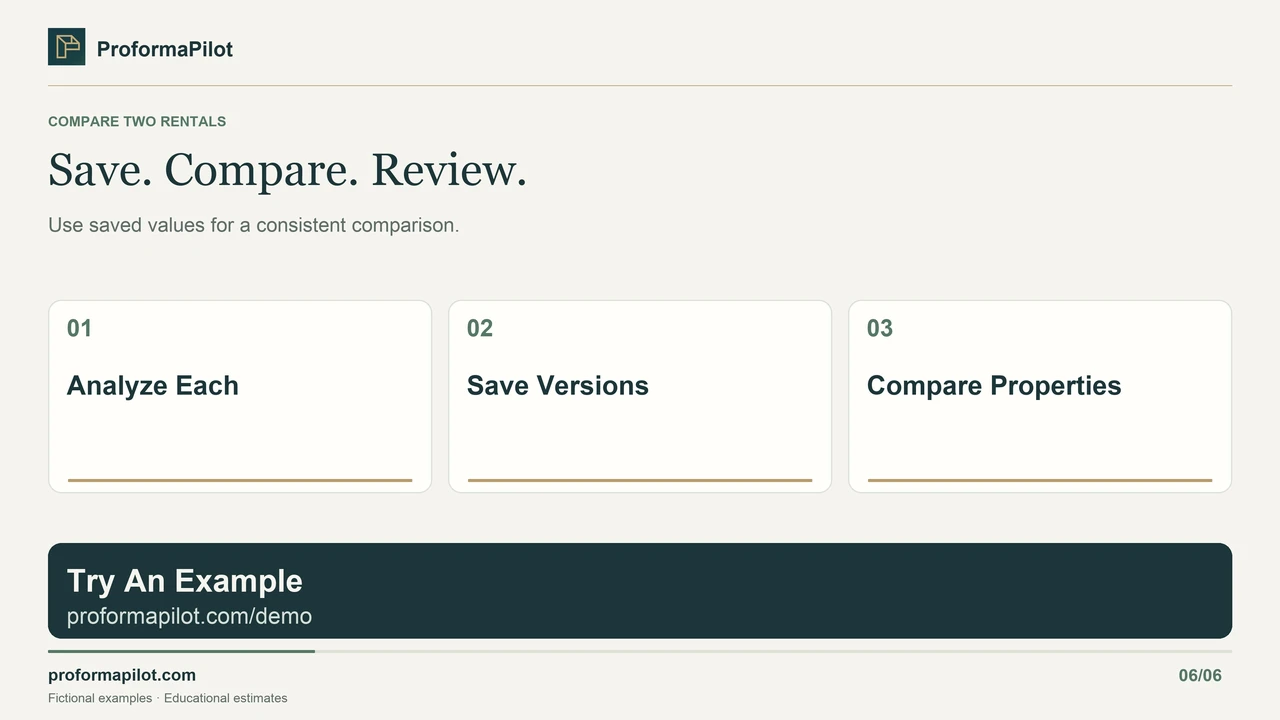
Save. Compare. Review.

Save. Compare. Review.: Use saved values for a consistent comparison.
Step 6 · Illustrated Overview

In ProformaPilot, analyze each rental, save its current version, and open Compare Properties. Use one property as your baseline and compare cash flow, cash required, and returns. Try a free example at ProformaPilot dot com.

Download Transcript

1. Compare More Than Advertised Rent

Rental A earns $2,800 per month; Rental B earns $2,400. With the same 5% vacancy allowance, effective income is $2,660 and $2,280, respectively.

These are fictional properties. A fair comparison uses consistent assumptions and verified rents, while still recognizing differences in location, condition, and tenant demand.

2. Deduct Costs, Reserves, And Financing

Rental A has $900 in operating costs, $140 in reserves, and a $1,450 principal-and-interest payment. Its projected monthly cash flow is $170.

Rental B has $700 in operating costs, $120 in reserves, and a $1,264 principal-and-interest payment. Its projected monthly cash flow is $196. The lower-rent property leaves $26 more each month under these assumptions.

3. Include Cash Needed To Begin

Suppose Rental A needs $100,000 upfront and Rental B needs $70,000. Annual projected cash flow is $2,040 and $2,352, respectively. Dividing by upfront cash gives illustrative cash-on-cash returns of 2.04% and 3.36%.

This measure is before income tax and excludes appreciation, principal paydown, and sale proceeds. It does not capture every risk, and it cannot establish that either property is a good investment.

4. Keep The Assumptions Beside The Results

Save reviewed versions of both properties, then use Compare Saved Properties to view their inputs and results together. Each saved version uses one Analysis Save.

Test vacancy, repairs, and financing changes. Confirm leases, inspections, permits, insurance, and lender terms before deciding which property deserves further investigation.

Worked Example

Higher Rent Does Not Always Leave More Cash

Fictional monthly figures before income tax. Loan payments and upfront cash are stated assumptions, not lender quotes. Cash-on-cash return excludes equity gains and sale proceeds.

Scheduled Rent · A / B
$2,800 / $2,400
Income After 5% Vacancy
$2,660 / $2,280
Operating Costs
$900 / $700
Capital Reserves
$140 / $120
Principal And Interest
$1,450 / $1,264
Monthly Cash Flow
$170 / $196
Cash Needed To Begin
$100,000 / $70,000
Annual Cash-On-Cash Return
2.04% / 3.36%

Keep These In Mind

  • Higher rent does not automatically mean higher cash flow.
  • Use consistent assumptions and compare starting cash.
  • Results help organize research; they do not replace verification.

Further Reading: CFPB: Principal And Interest Vs. Total Mortgage Payment. Separate principal and interest from escrowed taxes and insurance. Confirm actual financing and costs with your lender; the examples here are fictional.

Your Next Chapter

Continue Learning

A few useful lessons to explore next.

Explore All Learning Guides

Privacy Choices

Essential sign-in, payments, security, and usage limits stay on. Your choices apply to this browser for six months. Read Our Privacy Policy

Maps, suggestions, and drafts can also be enabled where you use them. Turning off drafts removes this browser’s recovery copies. Withdrawing maps or tracking reloads the page to stop the service; save any work first.