
← Learning Guides
A Clearer Start

Does Your Rental Still Work If The Rent Is Lower?

A small rent reduction can consume most of a property’s cash-flow cushion. Follow the budget through lower rent, then explore a separate higher-cost case.

4K Available · Captions Optional

Short Guided Video · Optional English Captions · Illustrative Examples

Read The Video Transcript

A Useful Question Before You Buy

A Useful Question Before You Buy: What if the rent is lower than you expect?
Step 1 · Illustrated Overview

The expected rent may make a rental look promising. But how much room does the budget leave if that rent is lower? Let's follow a fictional property through ProformaPilot's rent scenarios. We will change the rent, keep the other assumptions in place, and see what happens to monthly cash flow.

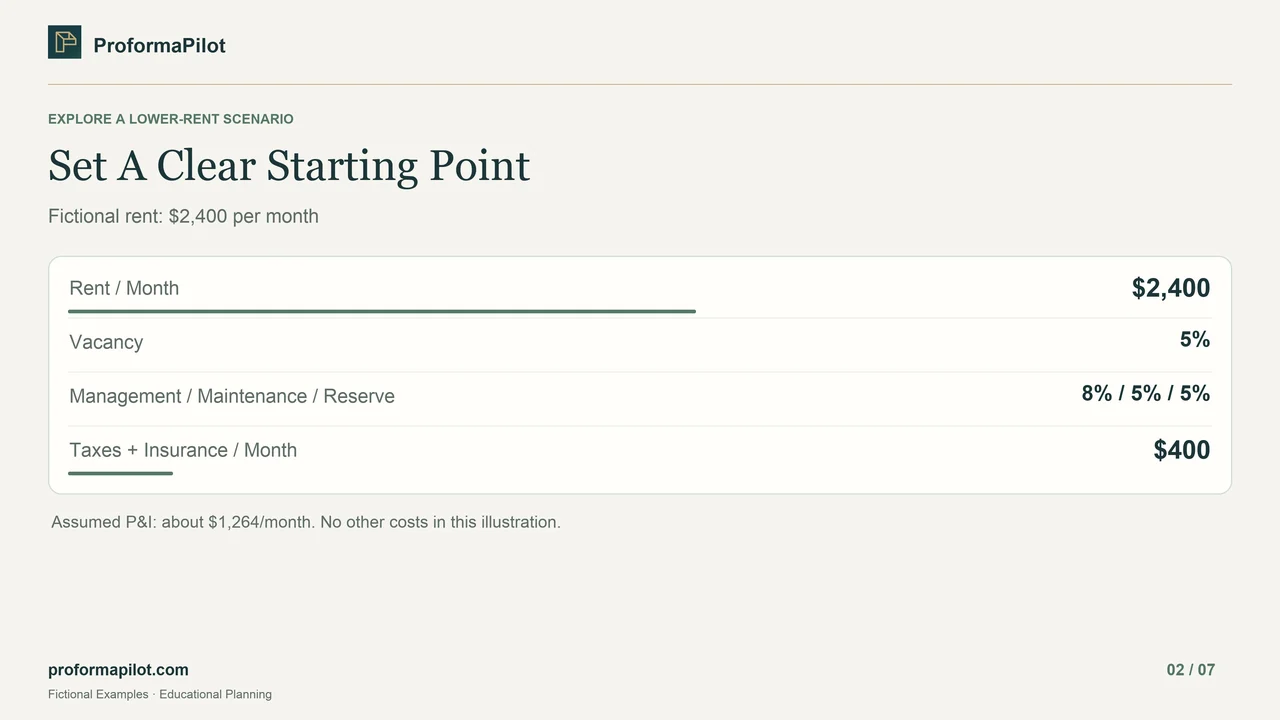
Set A Clear Starting Point

Set A Clear Starting Point: Fictional rent: $2,400 per month
Step 2 · Illustrated Overview

Our starting rent is twenty-four hundred dollars, with five percent vacancy. We allow eight percent for management, five for maintenance, and five for capital reserves, based on income after vacancy. Taxes and insurance total four hundred dollars a month. The two-hundred-thousand-dollar loan assumes six point five percent over thirty years, with no mortgage insurance.

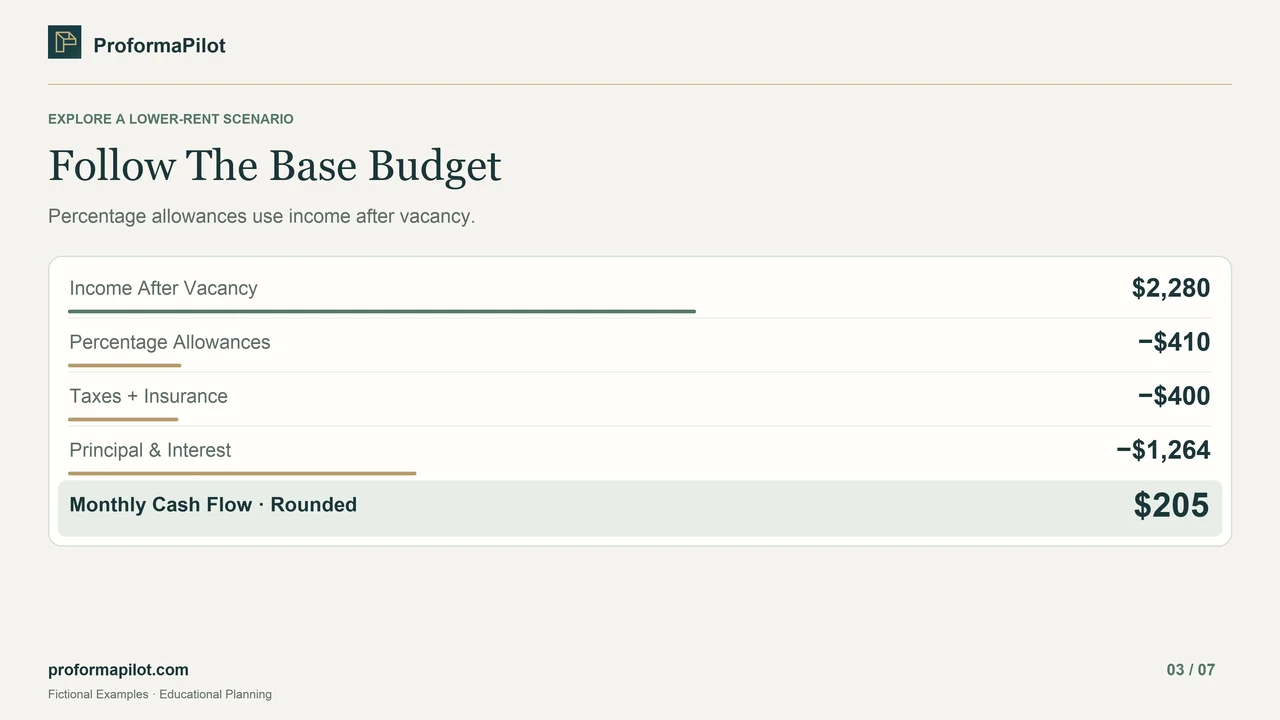
Follow The Base Budget

Follow The Base Budget: Percentage allowances use income after vacancy.
Step 3 · Illustrated Overview

After vacancy, income is twenty-two hundred eighty dollars. The three percentage allowances total about four hundred ten dollars, and taxes and insurance add four hundred. After the roughly twelve-hundred-sixty-four-dollar loan payment, about two hundred five dollars remains. These rounded display figures come from the unrounded calculation.

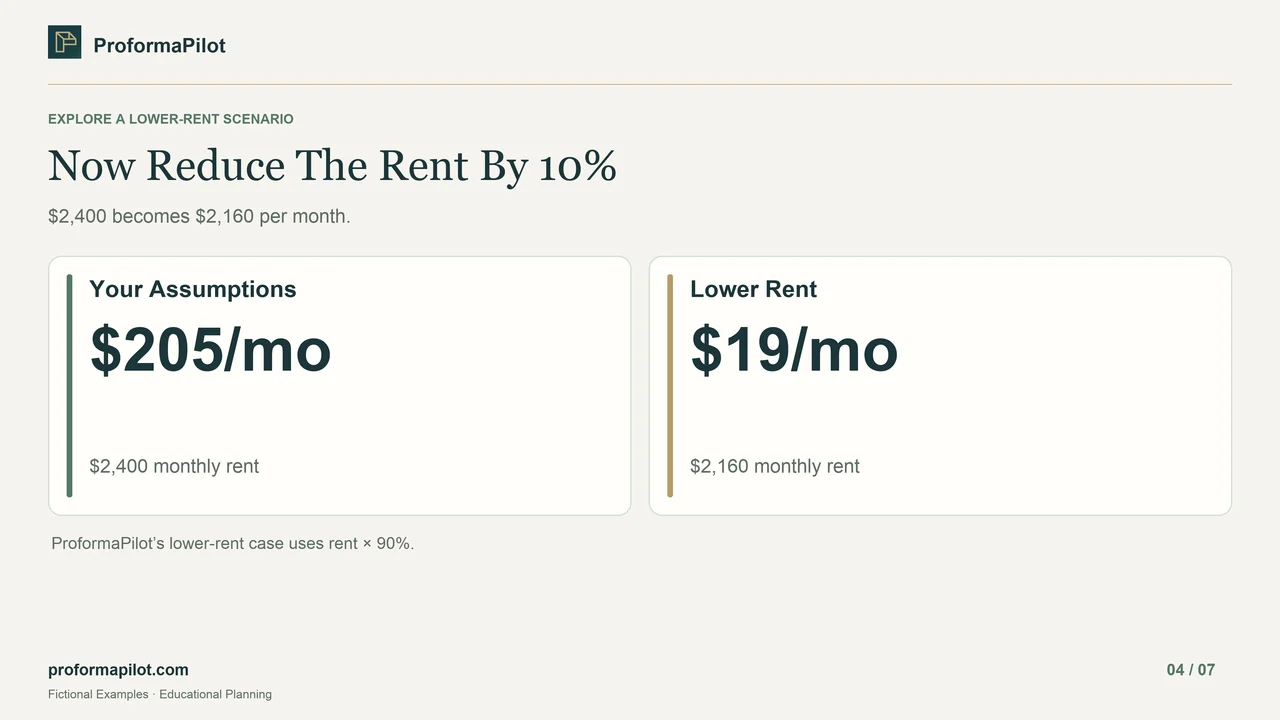
Now Reduce The Rent By 10%

Now Reduce The Rent By 10%: $2,400 becomes $2,160 per month.
Step 4 · Illustrated Overview

The lower-rent case uses twenty-one hundred sixty dollars. Vacancy and the percentage-based allowances adjust with the income; fixed costs and the loan payment stay the same. Monthly cash flow falls from about two hundred five dollars to just nineteen. The rent fell ten percent, but most of the cash-flow cushion disappeared.

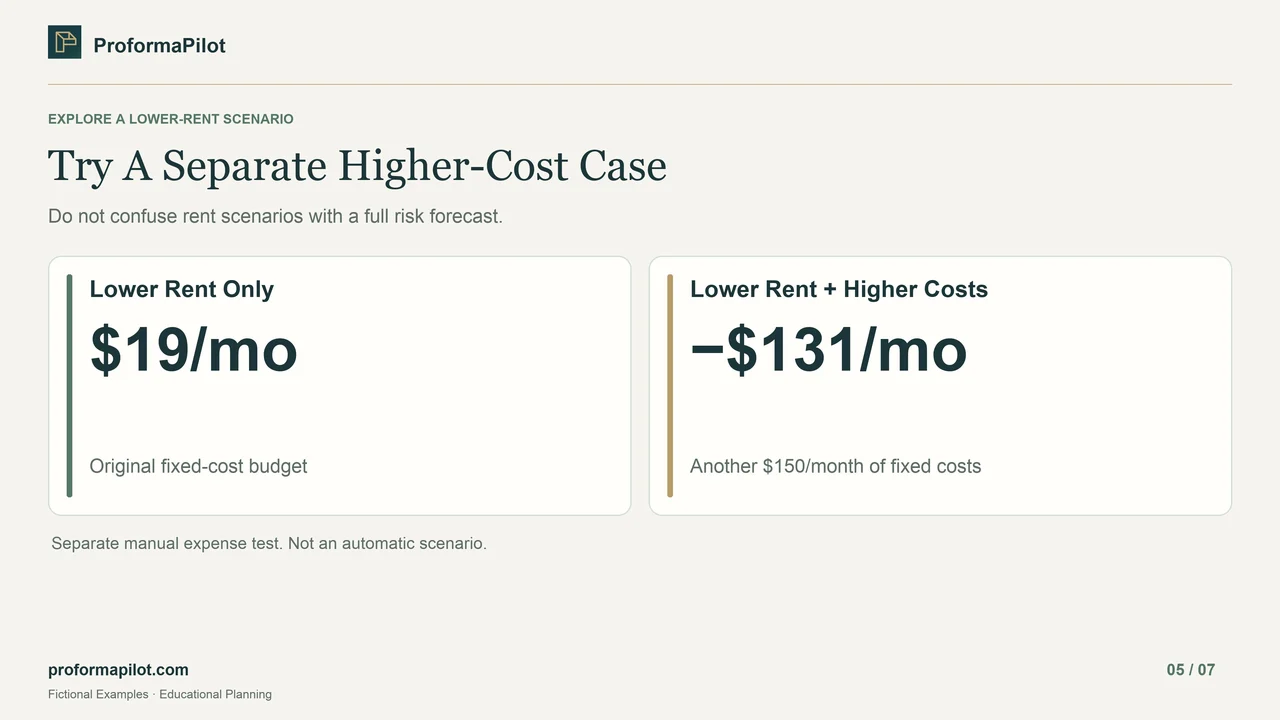
Try A Separate Higher-Cost Case

Try A Separate Higher-Cost Case: Do not confuse rent scenarios with a full risk forecast.
Step 5 · Illustrated Overview

What if fixed monthly costs also rise by one hundred fifty dollars? Enter that as a separate change to the expense assumptions. Combined with the lower rent, this example would be short about one hundred thirty-one dollars each month. The built-in rent scenarios do not automatically predict repairs or increase every expense. You choose those additional tests.

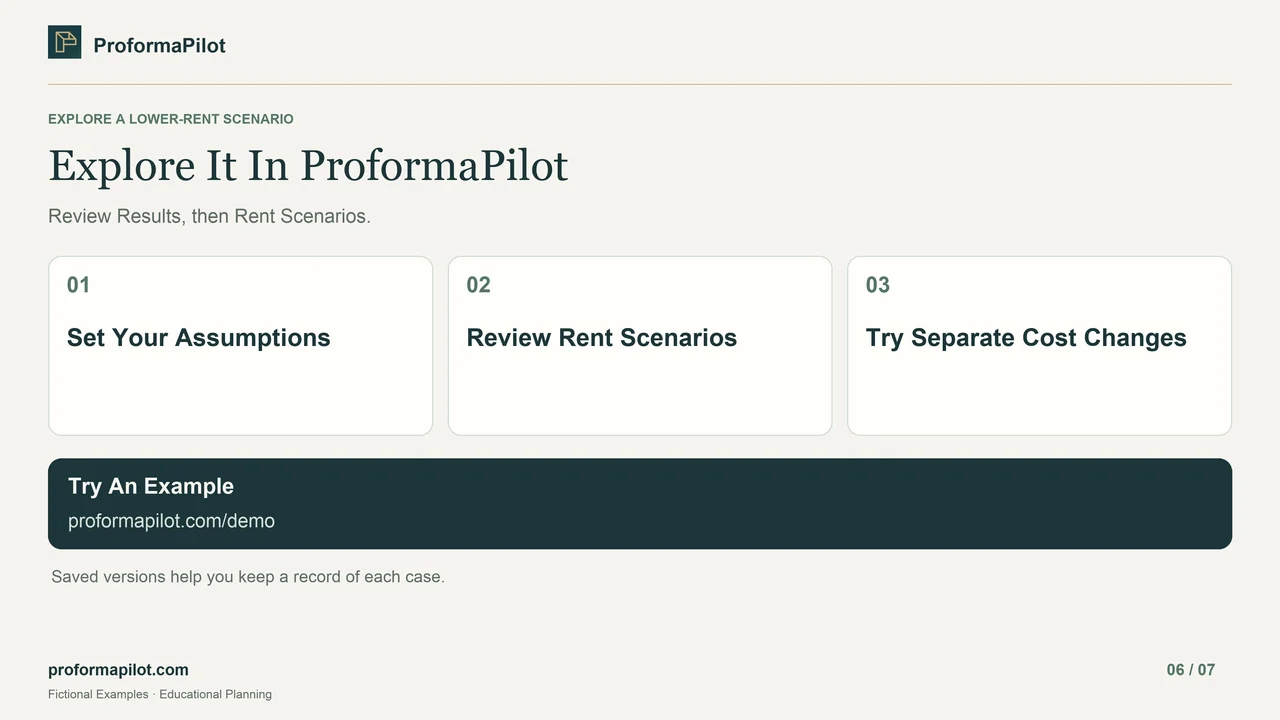
Explore It In ProformaPilot

Explore It In ProformaPilot: Set Your Assumptions; Review Rent Scenarios; Try Separate Cost Changes
Step 6 · Illustrated Overview

Open Residential Rental Analysis, enter the property's income, expenses, and purchase financing, then review Results and Rent Scenarios. Compare Lower Rent, Your Assumptions, and Higher Rent. To explore more vacancy or higher costs, change those inputs separately. Recalculating your assumptions does not request a fresh property lookup.

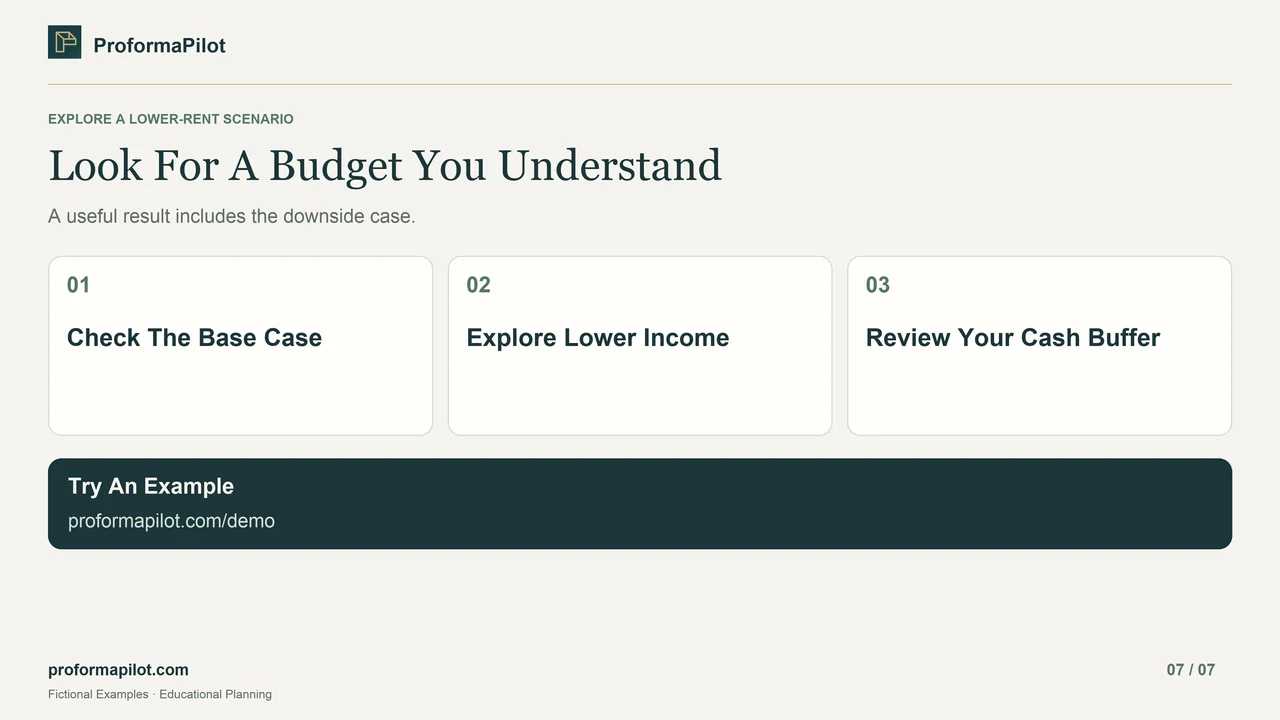
Look For A Budget You Understand

Look For A Budget You Understand: Check The Base Case; Explore Lower Income; Review Your Cash Buffer
Step 7 · Illustrated Overview

A positive base result is a starting point. The lower-rent case helps you understand how much room the budget leaves when income disappoints. Try the free example at ProformaPilot dot com slash demo. Work through the assumptions, verify local rents and costs, and keep a cash buffer appropriate for the property.

Download Transcript

1. A Useful Question Before You Buy

The expected rent may make a rental look promising. But how much room does the budget leave if that rent is lower?

Let's follow a fictional property through ProformaPilot's rent scenarios. We will change the rent, keep the other assumptions in place, and see what happens to monthly cash flow.

2. Set A Clear Starting Point

Our starting rent is twenty-four hundred dollars, with five percent vacancy. We allow eight percent for management, five for maintenance, and five for capital reserves, based on income after vacancy.

Taxes and insurance total four hundred dollars a month. The two-hundred-thousand-dollar loan assumes six point five percent over thirty years, with no mortgage insurance.

3. Follow The Base Budget

After vacancy, income is twenty-two hundred eighty dollars. The three percentage allowances total about four hundred ten dollars, and taxes and insurance add four hundred.

After the roughly twelve-hundred-sixty-four-dollar loan payment, about two hundred five dollars remains. These rounded display figures come from the unrounded calculation.

4. Now Reduce The Rent By 10%

The lower-rent case uses twenty-one hundred sixty dollars. Vacancy and the percentage-based allowances adjust with the income; fixed costs and the loan payment stay the same.

Monthly cash flow falls from about two hundred five dollars to just nineteen. The rent fell ten percent, but most of the cash-flow cushion disappeared.

5. Try A Separate Higher-Cost Case

What if fixed monthly costs also rise by one hundred fifty dollars? Enter that as a separate change to the expense assumptions.

Combined with the lower rent, this example would be short about one hundred thirty-one dollars each month. The built-in rent scenarios do not automatically predict repairs or increase every expense. You choose those additional tests.

6. Explore It In ProformaPilot

Open Residential Rental Analysis, enter the property's income, expenses, and purchase financing, then review Results and Rent Scenarios.

Compare Lower Rent, Your Assumptions, and Higher Rent. To explore more vacancy or higher costs, change those inputs separately. Recalculating your assumptions does not request a fresh property lookup.

Worked Example

Test The Cash-Flow Cushion

Fictional educational figures before income taxes. Rates, property values, rents, and costs are assumptions, not current market offers. Verify the figures for your own property.

Scheduled Rent · Base / Lower
$2,400 / $2,160
Monthly Cash Flow · Base / Lower
About $205 / $19
Separate Fixed-Cost Increase
$150 / Month
Lower Rent Plus Higher Costs
About −$131 / Month

Keep These In Mind

  • Lower rent affects vacancy-adjusted income and percentage-based costs.
  • Fixed costs and loan payments can leave little room for an income shortfall.
  • Rent scenarios do not automatically model every possible repair or cost increase.

Further Reading: CFPB: Mortgage Costs And Financing. Use the source to understand the underlying concepts, and confirm actual financing and property requirements with appropriate professionals.


Your Next Chapter

Continue Learning

A few useful lessons to explore next.

Explore All Learning Guides

Privacy Choices

Essential sign-in, payments, security, and usage limits stay on. Your choices apply to this browser for six months. Read Our Privacy Policy

Maps, suggestions, and drafts can also be enabled where you use them. Turning off drafts removes this browser’s recovery copies. Withdrawing maps or tracking reloads the page to stop the service; save any work first.