← Learning Guides
A Clearer Start

20% Or 30% Down? Cash Flow And Cash Needed

A larger down payment can lower the monthly loan payment. The other side of that choice is more cash needed upfront. Follow one fictional property through both scenarios.

4K Available · Captions Optional

Short Guided Video · Optional English Captions · Illustrative Examples

Read The Video Transcript

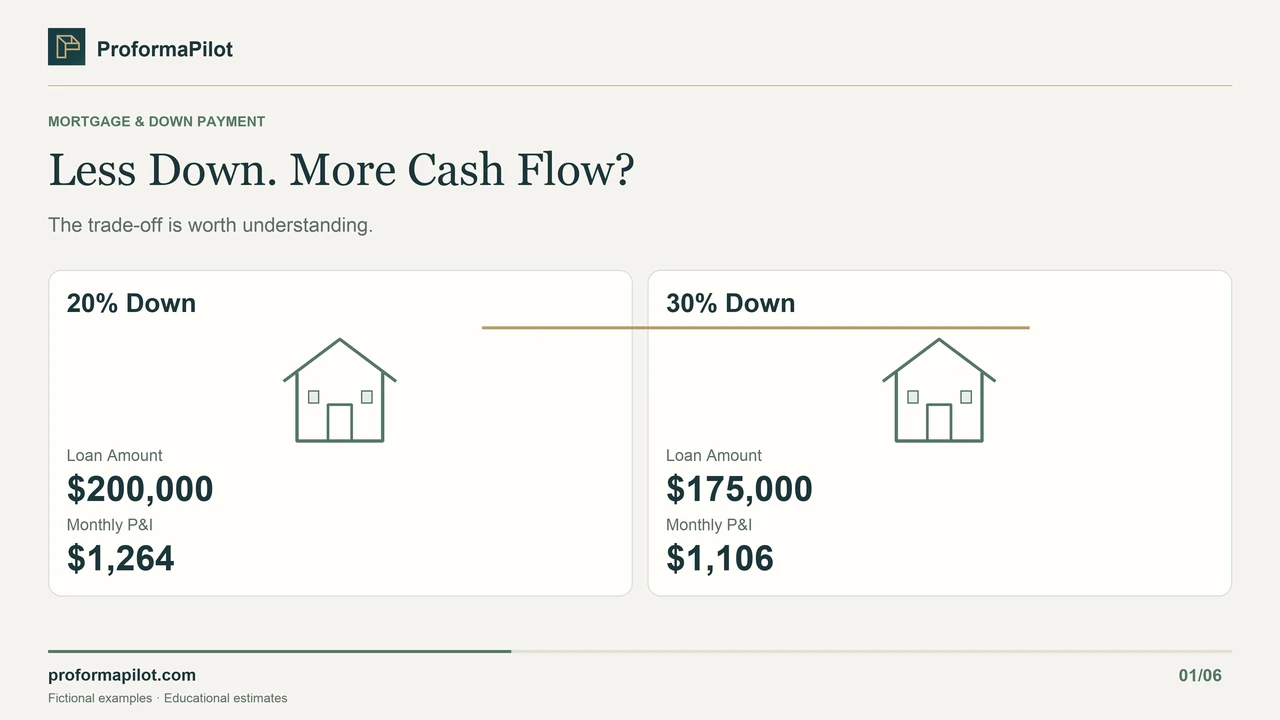
Less Down. More Cash Flow?

Less Down. More Cash Flow?: The trade-off is worth understanding.
Step 1 · Illustrated Overview

Putting less money down can leave more cash in your bank, but it also means a larger loan. Let’s follow one fictional rental through two financing choices.

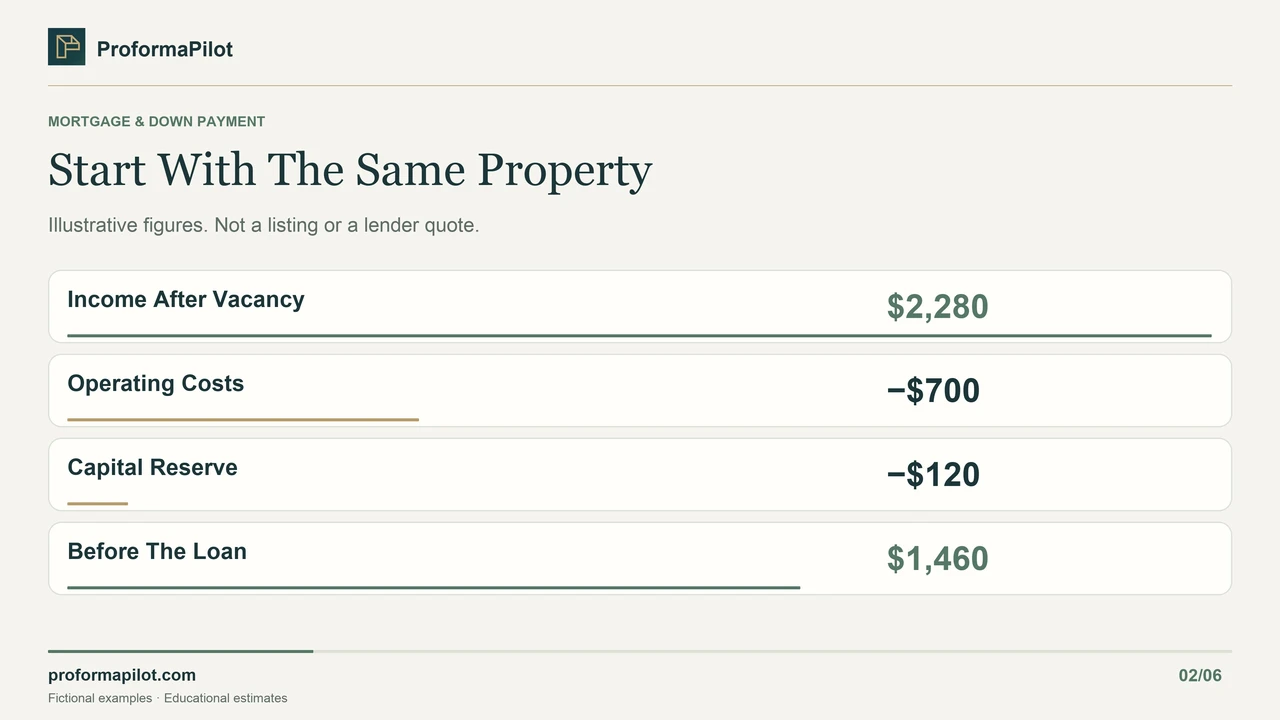
Start With The Same Property

Start With The Same Property: Illustrative figures. Not a listing or a lender quote.
Step 2 · Illustrated Overview

The purchase price is two hundred fifty thousand dollars, and monthly rent is twenty-four hundred dollars. After a five percent vacancy allowance, we have twenty-two hundred eighty dollars of income. Subtract seven hundred dollars of operating costs and a one hundred twenty dollar reserve.

Change The Down Payment

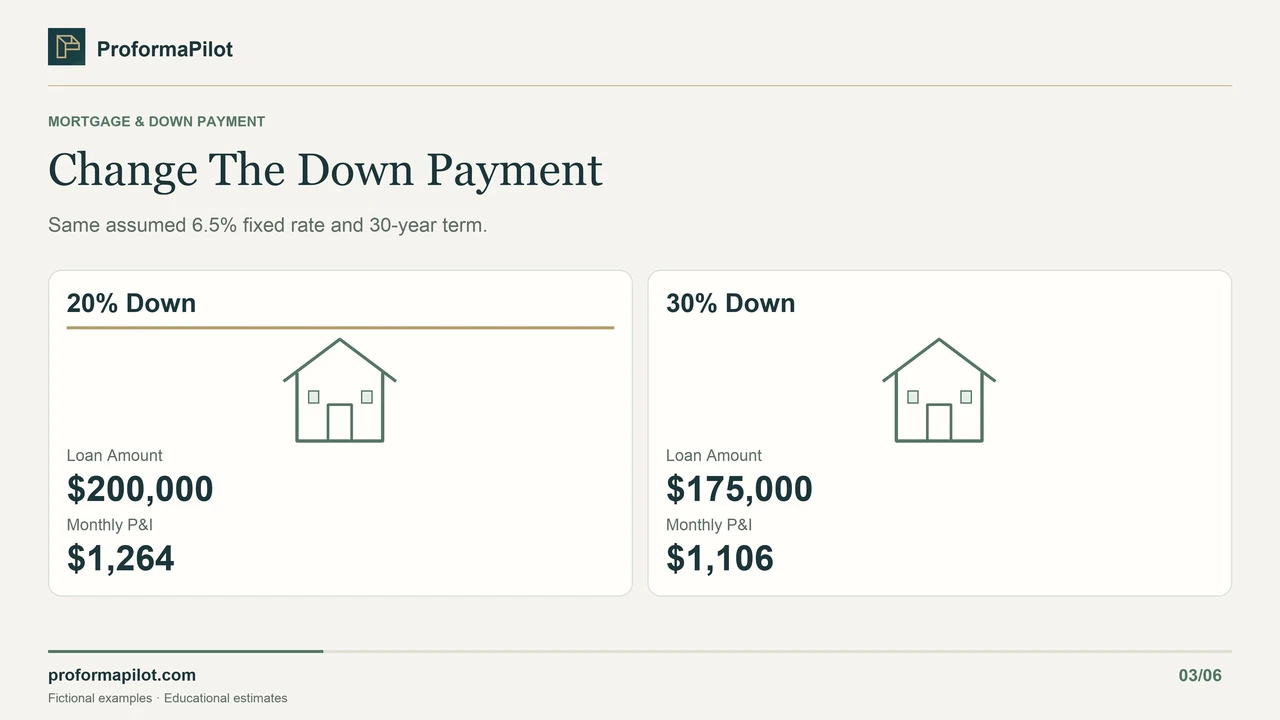
Change The Down Payment: Same assumed 6.5% fixed rate and 30-year term.
Step 3 · Illustrated Overview

With twenty percent down, the loan is two hundred thousand dollars, and principal and interest are about twelve hundred sixty-four dollars a month. With thirty percent down, the loan falls to one hundred seventy-five thousand dollars, and the payment is about eleven hundred six dollars.

See Both Sides Of The Trade-Off

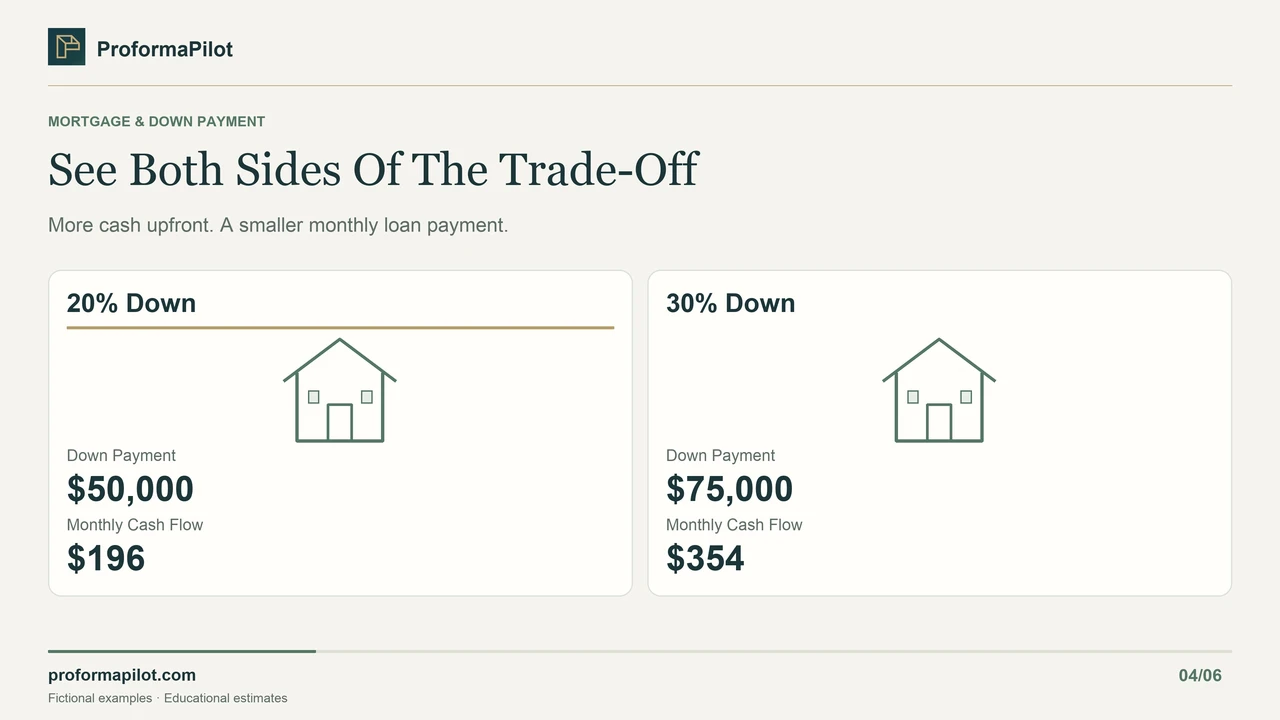
See Both Sides Of The Trade-Off: More cash upfront. A smaller monthly loan payment.
Step 4 · Illustrated Overview

The modeled cash flow rises from about one hundred ninety-six dollars to three hundred fifty-four dollars a month. But the down payment also rises by twenty-five thousand dollars. Include closing costs, repairs, and initial reserves before deciding how much cash you need.

Budget Each Cost Once

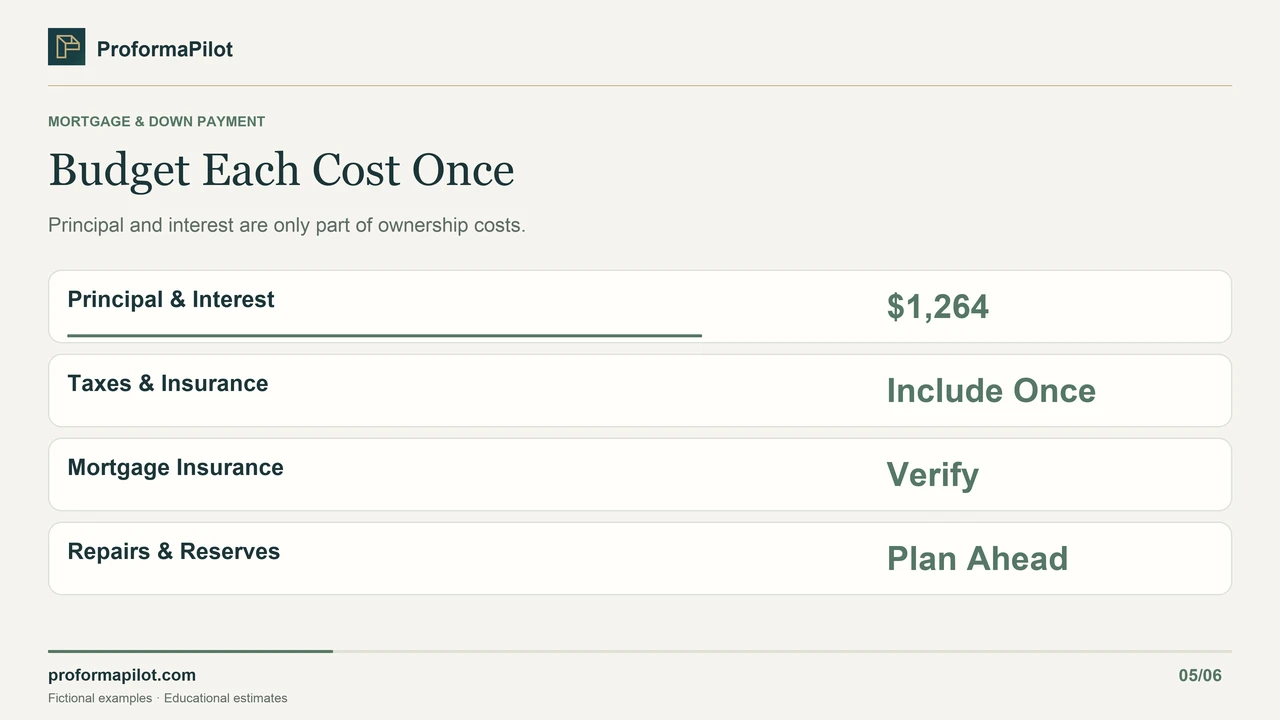
Budget Each Cost Once: Principal and interest are only part of ownership costs.
Step 5 · Illustrated Overview

Taxes, insurance, and mortgage insurance, when required, still matter. If your lender escrows taxes and insurance, do not count those bills twice. This example assumes no mortgage insurance. Get the actual payment, rate, and terms from your lender.

Try Your Own Financing Choices

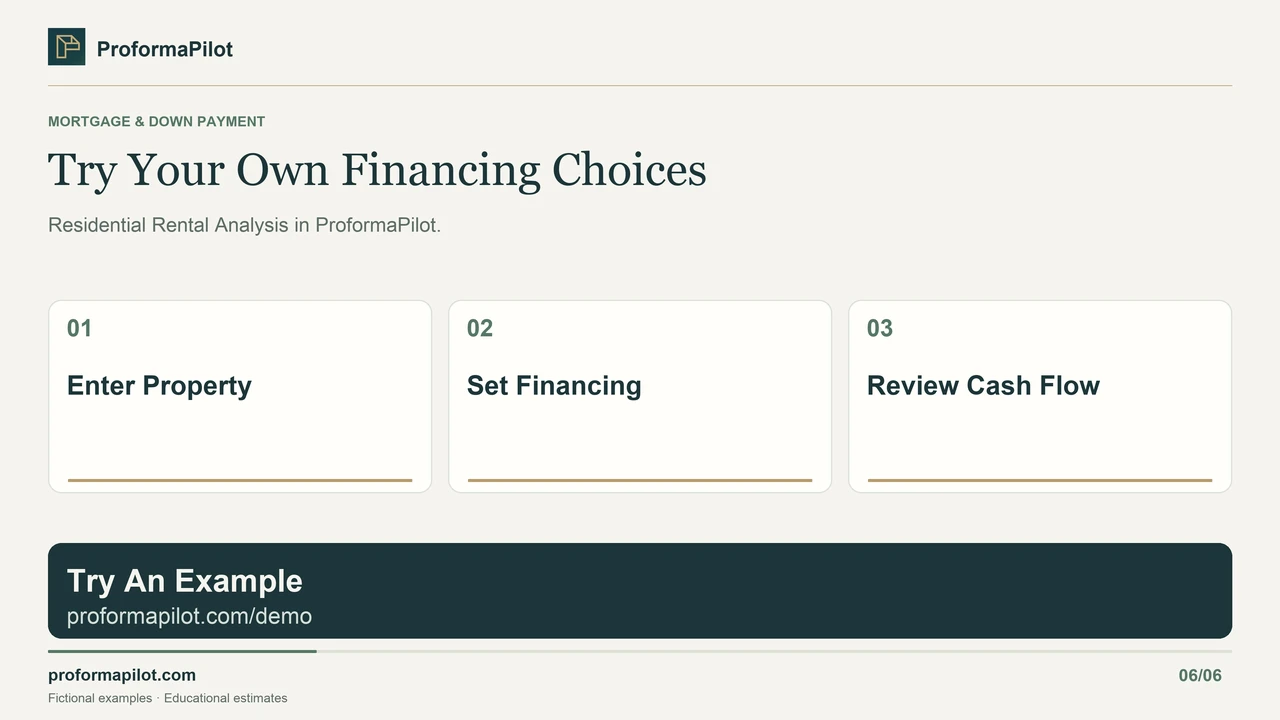
Try Your Own Financing Choices: Residential Rental Analysis in ProformaPilot.
Step 6 · Illustrated Overview

In ProformaPilot, choose Residential Rental Analysis, enter the property and purchase financing, and review your monthly budget. Change the down payment, check the effect, and save versions you want to compare. Start with the free example at ProformaPilot dot com.

Download Transcript

1. Hold The Property Budget Constant

Start with a $250,000 property and $2,400 in monthly scheduled rent. A 5% vacancy allowance leaves $2,280. Deduct $700 in operating costs and a $120 capital reserve allowance to leave $1,460 before principal and interest.

The operating costs already include taxes and insurance. Keeping them separate from the loan payment helps prevent double counting.

2. Change The Down Payment

At an assumed 6.5% fixed rate over 30 years, 20% down means a $50,000 down payment and a $200,000 loan. Principal and interest are about $1,264 per month.

At 30% down, the down payment becomes $75,000 and the loan falls to $175,000. Principal and interest are about $1,106 per month. The example assumes the same rate and term and includes no mortgage insurance. Actual quotes may differ.

3. Compare Cash Flow With Upfront Cash

Projected monthly cash flow increases from about $196 to $354, while the down payment rises by $25,000. That is about $158 less in monthly principal and interest; it is not a guaranteed investment return.

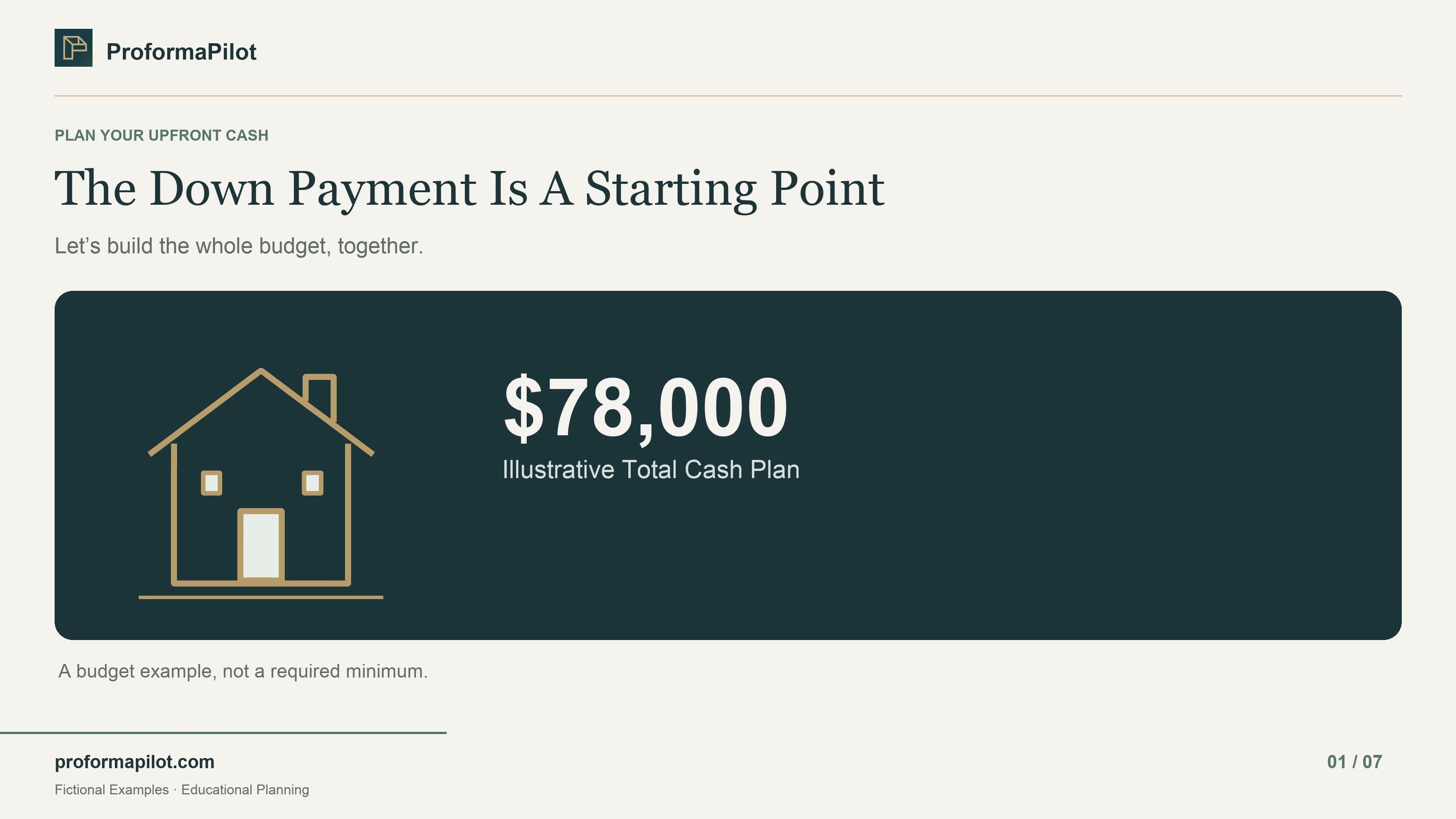
The down payment is only part of the starting cash needed. Include closing costs, initial repairs, and reserves. Keep a cash buffer rather than assuming every available dollar belongs in the down payment.

4. Test Your Own Financing

In Residential Rental Analysis, enter the same property budget and change the down payment in Purchase & Financing. Review the cash-needed and monthly cash-flow results together.

Test lower rent or higher costs before saving. Confirm lender requirements, rates, fees, and any mortgage insurance independently.

Worked Example

One Property, Two Financing Choices

Fictional stabilized figures before income tax. Same 6.5% fixed rate and 30-year term; no mortgage insurance. Down payments exclude closing costs, repairs, and initial reserves.

Down Payment · 20% / 30%
$50,000 / $75,000
Loan Amount
$200,000 / $175,000
Monthly Principal And Interest
About $1,264 / $1,106
Monthly Cash Flow
About $196 / $354
Additional Down Payment
$25,000

Keep These In Mind

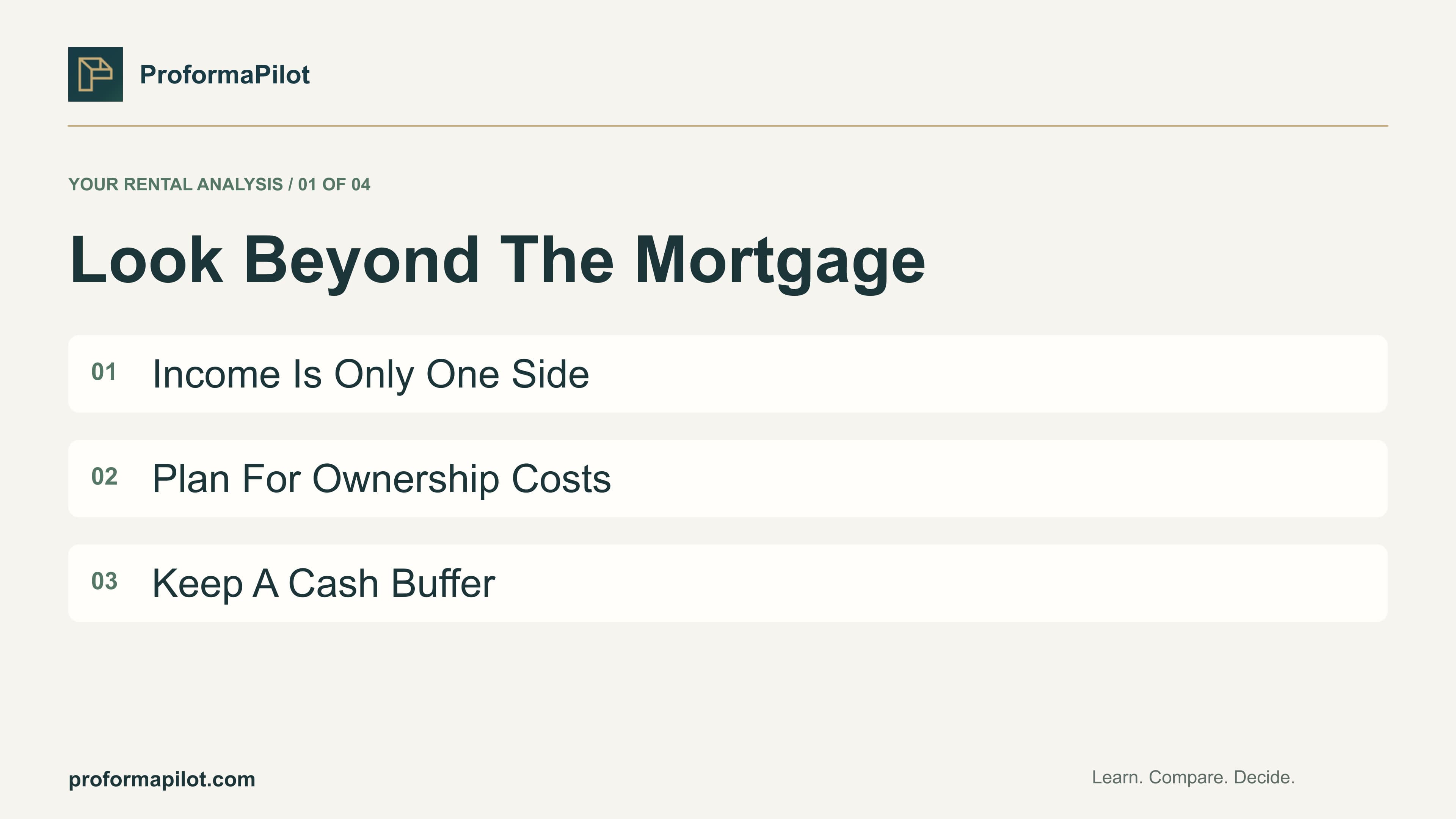
  • Review monthly cash flow and starting cash together.
  • Confirm lender terms and keep ownership costs separate.
  • Leave room for repairs, vacancy, and reserves.

Further Reading: CFPB: Principal And Interest Vs. Total Mortgage Payment. Separate principal and interest from escrowed taxes and insurance. Confirm actual financing and costs with your lender; the examples here are fictional.
Your Next Chapter

Continue Learning

A few useful lessons to explore next.

Explore All Learning Guides

Privacy Choices

Essential sign-in, payments, security, and usage limits stay on. Your choices apply to this browser for six months. Read Our Privacy Policy

Maps, suggestions, and drafts can also be enabled where you use them. Turning off drafts removes this browser’s recovery copies. Withdrawing maps or tracking reloads the page to stop the service; save any work first.