← Learning Guides
A Clearer Start

One Property, Two Rents: Analyzing A Home With An ADU

Give the main home and accessory dwelling unit their own rent assumptions, then review one complete property budget. More rent still needs a clear view of costs and verification.

4K Available · Captions Optional

Short Guided Video · Optional English Captions · Illustrative Examples

Read The Video Transcript

Two Rents. One Property Budget.

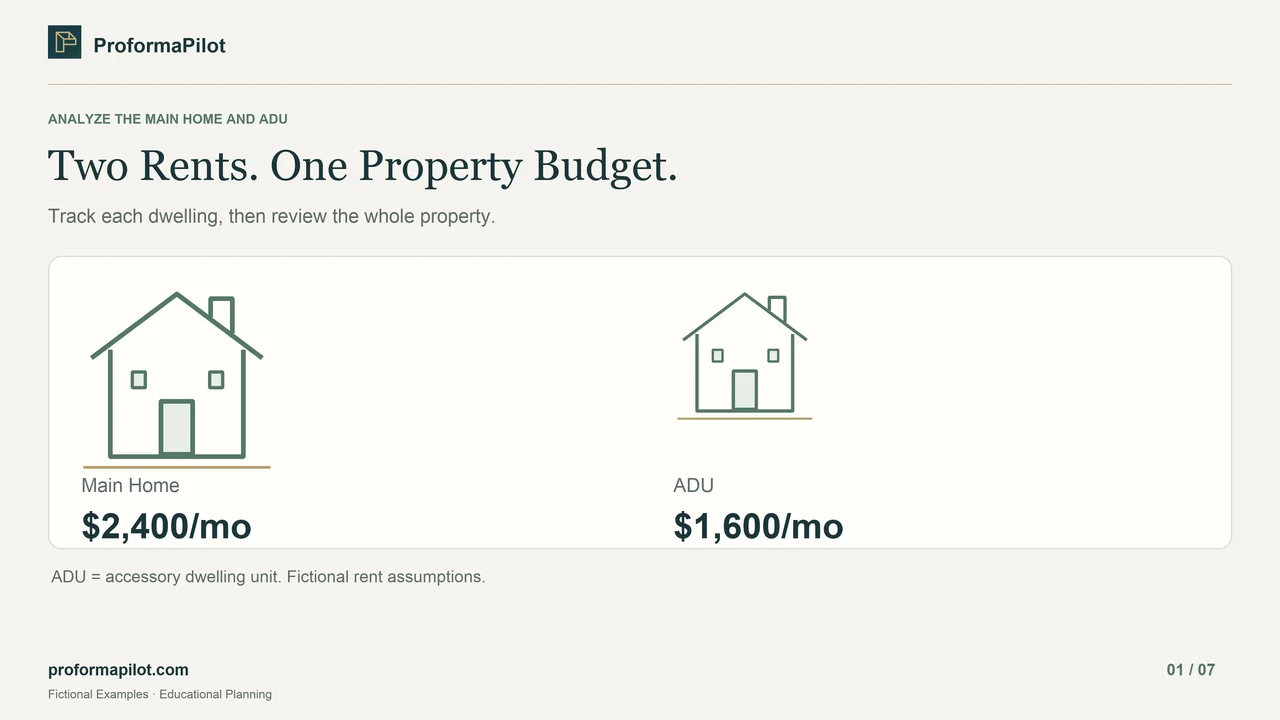
Two Rents. One Property Budget.: Track each dwelling, then review the whole property.
Step 1 · Illustrated Overview

A main home and an ADU can have different rents, conditions, and costs. Let's give each dwelling its own assumptions, then bring the property budget together. This fictional example has an existing main home renting for twenty-four hundred dollars and an accessory dwelling renting for sixteen hundred. Those rents still need verification.

Begin With The Rent Schedule

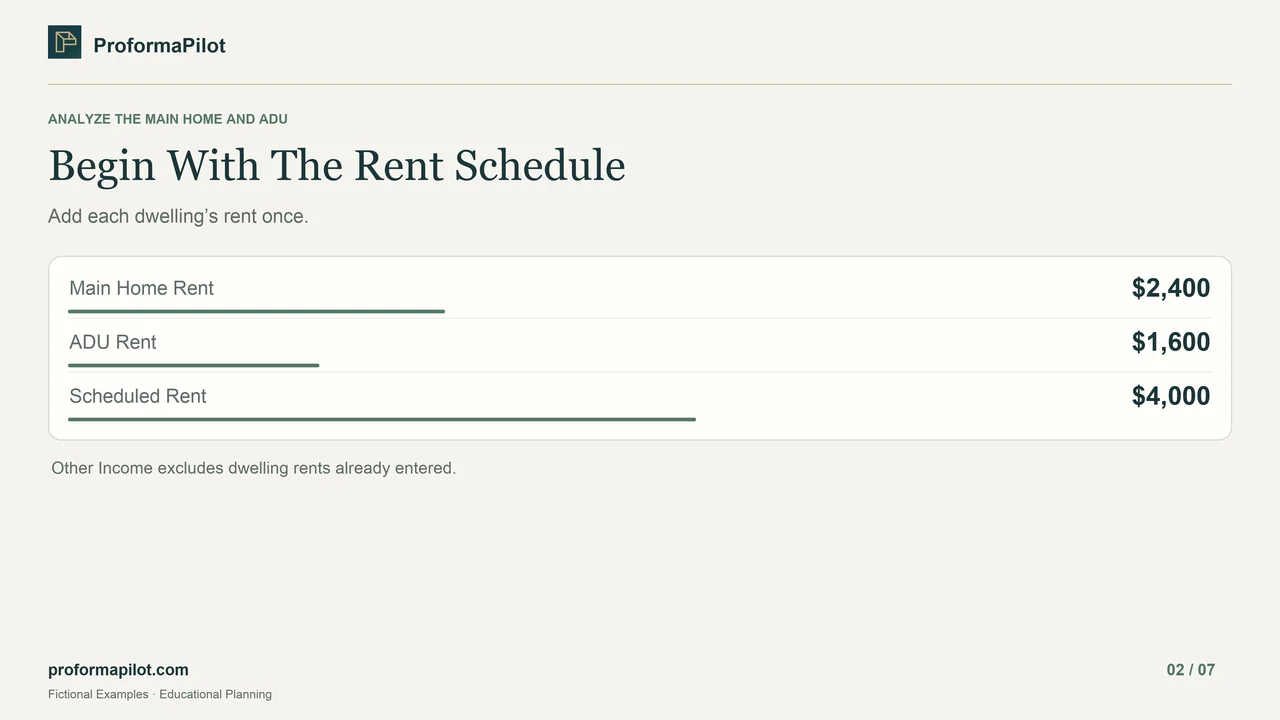
Begin With The Rent Schedule: Add each dwelling’s rent once.
Step 2 · Illustrated Overview

Together, those rents add up to four thousand dollars a month before vacancy or any costs. It is scheduled income, not profit. In ProformaPilot, set up the dwelling schedule under Main Home And ADUs. Enter each dwelling's rent separately. Do not put those same rents into Other Income, or the analysis would count them twice.

Distinguish Existing From Planned

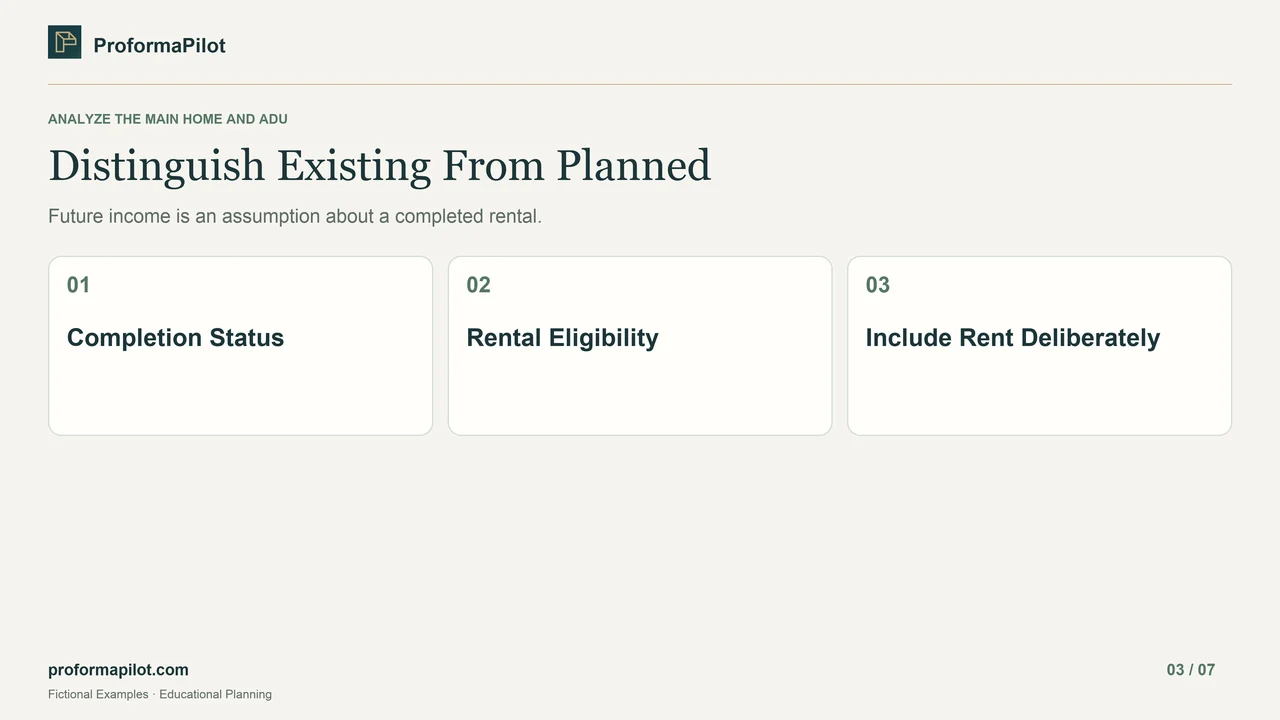
Distinguish Existing From Planned: Completion Status; Rental Eligibility; Include Rent Deliberately
Step 3 · Illustrated Overview

For each dwelling, record whether it is existing, planned, or under construction. Review the permit and rental-approval status, and decide whether its rent should be included. Including planned dwelling rent creates a stabilized scenario after completion and lease-up. It does not mean that income is available today, or that the project has been approved.

Give Extra Costs A Place

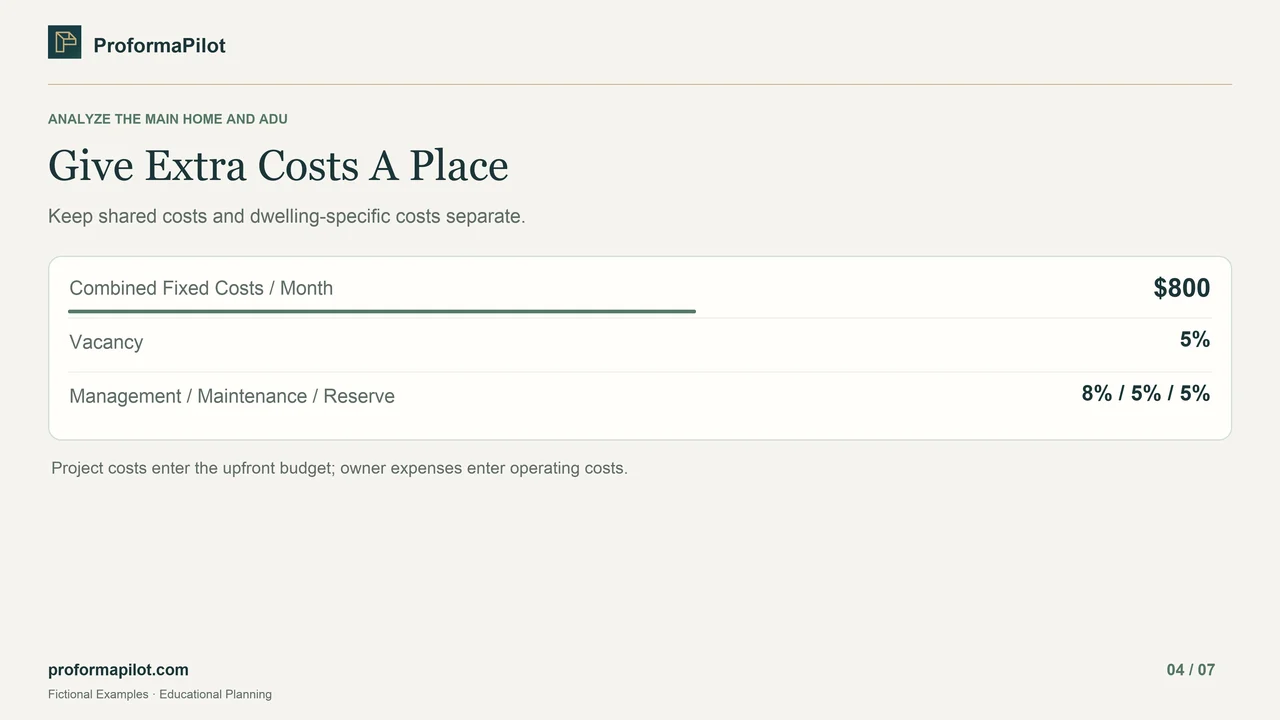
Give Extra Costs A Place: Keep shared costs and dwelling-specific costs separate.
Step 4 · Illustrated Overview

Add the extra dwelling's project budget and owner-paid expenses where they belong. Keep property-wide taxes, insurance, and financing in the shared budget. For this illustration, shared and dwelling-specific fixed costs total eight hundred dollars a month. We also use five percent vacancy, eight percent management, five percent maintenance, and five percent capital reserves.

Review What Remains

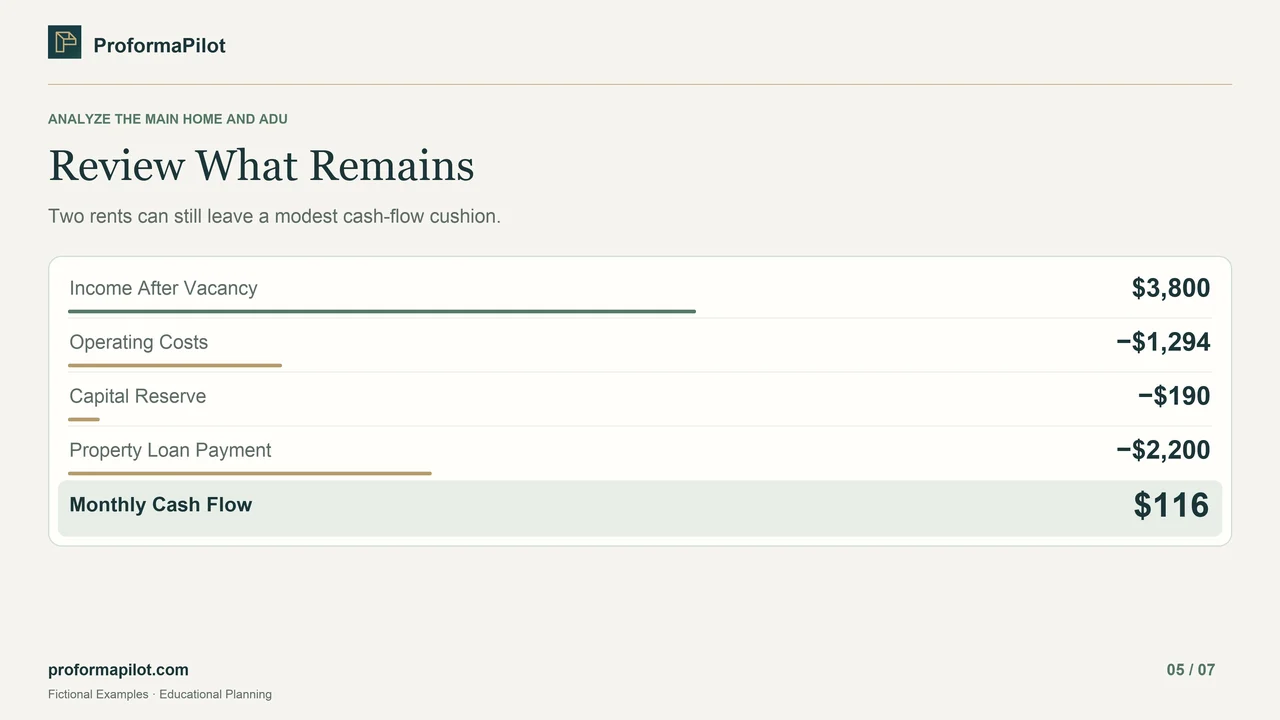
Review What Remains: Two rents can still leave a modest cash-flow cushion.
Step 5 · Illustrated Overview

The scheduled rent of four thousand dollars becomes thirty-eight hundred dollars after vacancy. Operating costs total one thousand two hundred ninety-four dollars, including management, maintenance, and the eight hundred dollars in fixed costs. Capital reserves use another one hundred ninety dollars. After the twenty-two-hundred-dollar property loan payment, one hundred sixteen dollars remains. More rental income does not remove the need to examine the full budget.

Verify The Details Before Relying On Them

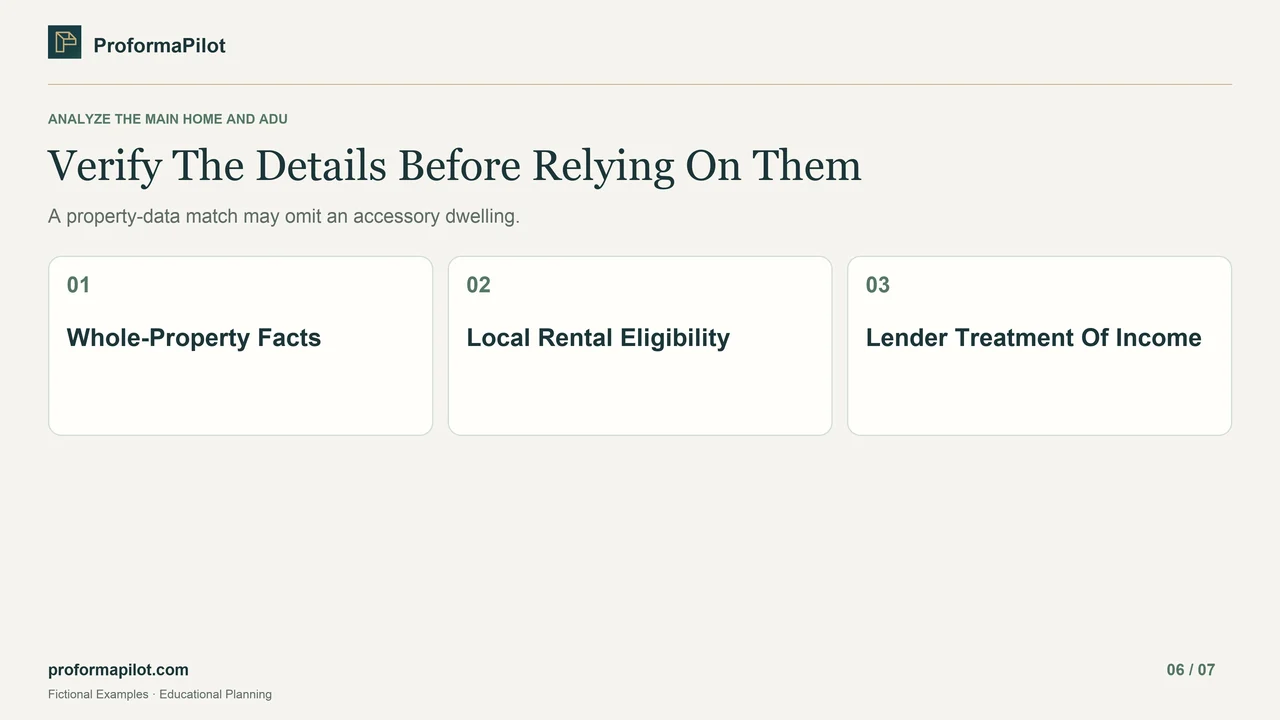
Verify The Details Before Relying On Them: Whole-Property Facts; Local Rental Eligibility; Lender Treatment Of Income
Step 6 · Illustrated Overview

Check the whole property against records, the listing, and what you know. A data provider may not separately identify the ADU or its rent. Confirm local rental eligibility and realistic income with appropriate professionals. Ask your lender how the accessory income is treated. The application's verification status records your review; it does not independently approve a dwelling.

Keep Each Assumption Visible

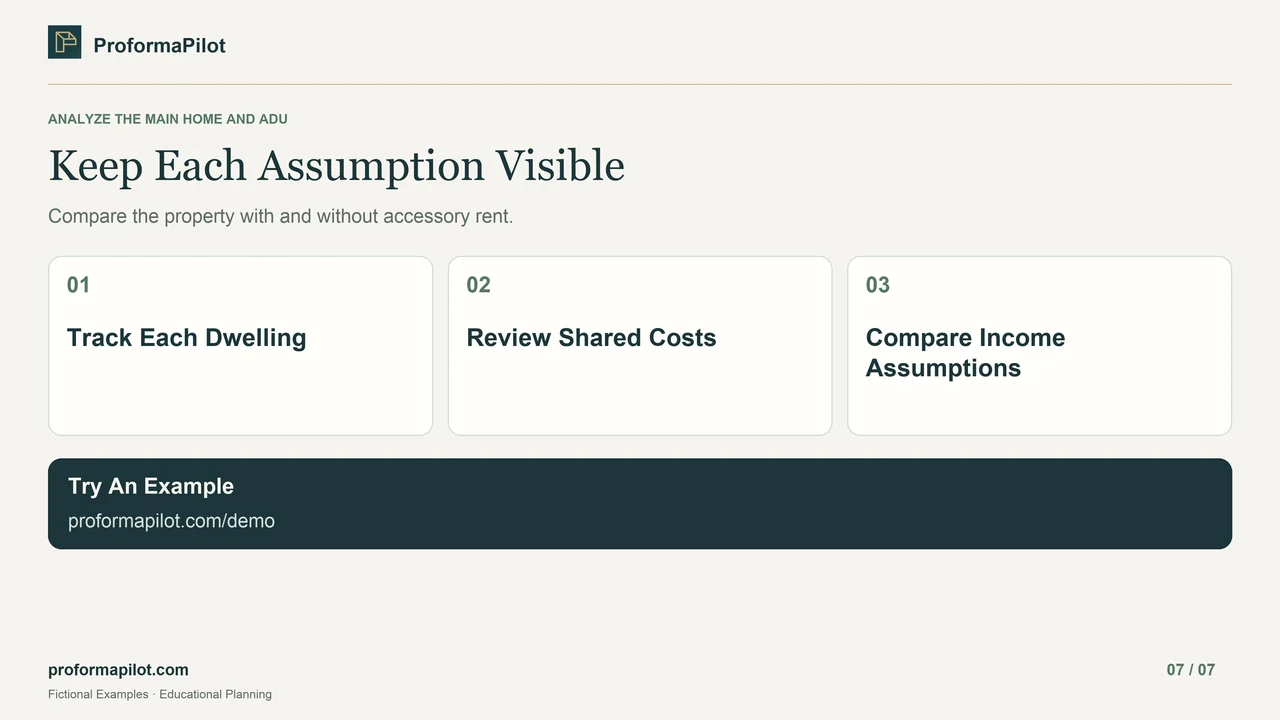
Keep Each Assumption Visible: Track Each Dwelling; Review Shared Costs; Compare Income Assumptions
Step 7 · Illustrated Overview

Review the dwelling summary and whole-property results in ProformaPilot. Try excluding accessory rent while retaining the costs that still apply, then compare saved versions. Start with the free example at ProformaPilot dot com slash demo. Separate the rents, count each cost once, and keep the distinction between today's income and future plans clear.

Download Transcript

1. Two Rents. One Property Budget.

A main home and an ADU can have different rents, conditions, and costs. Let's give each dwelling its own assumptions, then bring the property budget together.

This fictional example has an existing main home renting for twenty-four hundred dollars and an accessory dwelling renting for sixteen hundred. Those rents still need verification.

2. Begin With The Rent Schedule

Together, those rents add up to four thousand dollars a month before vacancy or any costs. It is scheduled income, not profit.

In ProformaPilot, set up the dwelling schedule under Main Home And ADUs. Enter each dwelling's rent separately. Do not put those same rents into Other Income, or the analysis would count them twice.

3. Distinguish Existing From Planned

For each dwelling, record whether it is existing, planned, or under construction. Review the permit and rental-approval status, and decide whether its rent should be included.

Including planned dwelling rent creates a stabilized scenario after completion and lease-up. It does not mean that income is available today, or that the project has been approved.

4. Give Extra Costs A Place

Add the extra dwelling's project budget and owner-paid expenses where they belong. Keep property-wide taxes, insurance, and financing in the shared budget.

For this illustration, shared and dwelling-specific fixed costs total eight hundred dollars a month. We also use five percent vacancy, eight percent management, five percent maintenance, and five percent capital reserves.

5. Review What Remains

The scheduled rent of four thousand dollars becomes thirty-eight hundred dollars after vacancy. Operating costs total one thousand two hundred ninety-four dollars, including management, maintenance, and the eight hundred dollars in fixed costs.

Capital reserves use another one hundred ninety dollars. After the twenty-two-hundred-dollar property loan payment, one hundred sixteen dollars remains. More rental income does not remove the need to examine the full budget.

6. Verify The Details Before Relying On Them

Check the whole property against records, the listing, and what you know. A data provider may not separately identify the ADU or its rent.

Confirm local rental eligibility and realistic income with appropriate professionals. Ask your lender how the accessory income is treated. The application's verification status records your review; it does not independently approve a dwelling.

Worked Example

One Complete Monthly Property Budget

Fictional educational figures before income taxes. Rates, property values, rents, and costs are assumptions, not current market offers. Verify the figures for your own property.

Main Home Rent
$2,400
ADU Rent
$1,600
Income After 5% Vacancy
$3,800
Operating Costs · Including $800 Fixed Costs
−$1,294
Capital Reserves
−$190
Property Loan Payment
−$2,200
Monthly Cash Flow
$116

Keep These In Mind

  • Count each dwelling’s rent and costs once.
  • Distinguish income available now from a planned, stabilized scenario.
  • Verify rental eligibility, permits, and lender treatment independently.

Further Reading: Fannie Mae: Accessory Dwelling Units. Use the source to understand the underlying concepts, and confirm actual financing and property requirements with appropriate professionals.
Your Next Chapter

Continue Learning

A few useful lessons to explore next.

Explore All Learning Guides

Privacy Choices

Essential sign-in, payments, security, and usage limits stay on. Your choices apply to this browser for six months. Read Our Privacy Policy

Maps, suggestions, and drafts can also be enabled where you use them. Turning off drafts removes this browser’s recovery copies. Withdrawing maps or tracking reloads the page to stop the service; save any work first.